
Small business IT support cost depends mostly on how you buy it. Published price guides put fully managed IT at roughly $100 to $250 per user per month and hourly break-fix help at roughly $75 to $225, and the final figure moves with security tooling, response times, devices and the state of your systems today. This guide covers the five pricing models, what drives the number, and what a fair quote must include.
Most IT providers hide their prices behind a "request a quote" button, which makes it hard to know whether an offer is reasonable. This guide does the opposite. It gives the ranges that managed service providers (MSPs) publish, works through the arithmetic for 10, 25 and 50 people, compares outsourcing with hiring, lists the exclusions that turn a cheap quote into an expensive year, and ends with our own starting prices.
Small business IT support cost at a glance
There is no single price, because "IT support" covers everything from fixing a printer to running your security. What you can compare is the pricing model. These are the five you will meet, with the ranges that published MSP price guides give. Treat every figure as a starting point: they vary by provider, region and scope.
| Model | How you pay | Published range | Fits when |
|---|---|---|---|
| Break-fix | By the hour, when something breaks | About $75 to $225 an hour | You have a few devices and little at stake |
| Managed, per user | A monthly fee for each employee | About $100 to $250 per user per month | You want one provider accountable for everything |
| Per device | A fee for each workstation, server and firewall | About $50 to $100 per workstation, $100 to $400 per server, $30 to $75 per firewall | Your estate is mostly equipment rather than people |
| Flat fee or tiers | One price for a written scope | One guide's example: about $7,500 a month for 40 people | You want a predictable bill with clear boundaries |
| Co-managed or project | Outside help beside your own IT person, or a fixed fee per job | Quoted case by case | You already employ IT staff, or need a migration or rebuild |
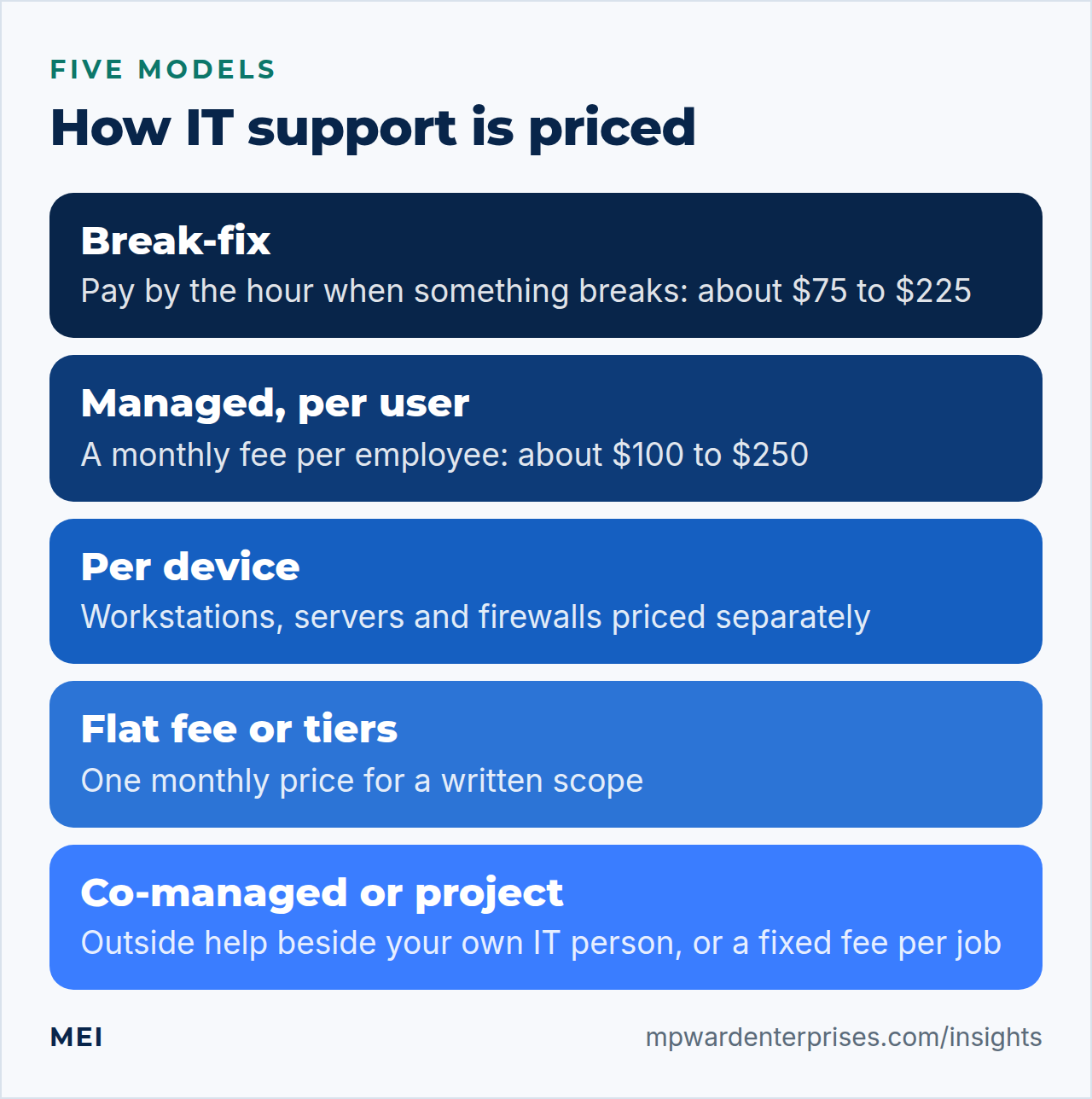
The five ways small business IT support is priced
1. Break-fix IT support: pay by the hour
With break-fix, you call when something is broken and pay for the time it takes to fix it. There is no contract and no monthly fee, which is its appeal. Published hourly rates run from about $75 to $225, depending on the provider and the skill the job needs.
The weakness is the incentive. A break-fix provider earns more when your systems fail, and nobody is paid to prevent the failure. Patching, backup testing and monitoring happen only if you ask for them and pay for them. It suits a handful of computers with little at stake, and it is a poor fit once email, customer records or card payments depend on the network.
2. Managed IT: a monthly fee per user
This is the model most people mean by managed IT support for small business. You pay a monthly amount for each employee, and the provider takes responsibility for the help desk, monitoring, patching, Microsoft 365 or Google Workspace administration, a security baseline, backup oversight and reporting. One 2026 guide puts the range at $100 to $250 per user per month; another, from 2025, says $100 to $150; a third spans $50 to $250 and above.
Per-user pricing is easy to budget, because adding a person adds one line. Ask what counts as a user, including whether part-timers, shared mailboxes and contractors are billed. Ask, too, what is bundled. A low per-user price that leaves out the security tools is not a low price.
3. Per device: workstations, servers and firewalls
Some providers price the equipment instead of the people. One guide lists about $50 to $100 per workstation, $100 to $400 per server and $30 to $75 per firewall, without stating the billing period, so confirm in writing whether a figure is monthly or one-off. Per-device pricing can suit a business with few staff and a lot of equipment. It can also surprise you, because every new device is a new charge.
4. Flat fee or tiered managed IT plans
A flat fee gives you one monthly price for a defined scope, often in Essential, Growth and Pro style tiers. It buys predictability, and the best versions are written down: what is covered, what is excluded and how fast the provider responds. One guide's example is roughly $7,500 a month for a 40-person company, which works out to $187.50 a user, inside the per-user band, with a small premium for the certainty.
Our own Managed Website & IT Care plans work this way: a written scope of covered systems, support time and response targets.
5. Co-managed IT support and projects
If you already employ an IT person, co-managed support puts an outside team behind them for after-hours cover, security, vacation gaps and the projects they have no time for. Projects, such as a migration, a server replacement or a website rebuild, are usually priced as a fixed fee per job rather than monthly. Neither has a standard price, so ask for a written scope and a total.
What drives small business IT support cost
Headcount sets the baseline, but it is rarely the biggest lever. One MSP guide calls security scope the single biggest swing factor in a quote, ranging from basic antivirus to a full endpoint detection and response program. These are the factors that move a small business IT support cost up or down.
| Factor | Lowers the price | Raises the price |
|---|---|---|
| Security scope | Antivirus, multi-factor authentication and patching | Endpoint detection and response, managed detection, email security, awareness training |
| Hours of cover | Business hours, handled remotely | After-hours and weekend response, on-site visits |
| Your environment | Standard devices, cloud apps, up-to-date documentation | Ageing or mixed equipment, on-premises servers, nothing written down |
| Compliance | No special rules | Industry regulation, client questionnaires, cyber-insurance conditions |
| Response targets | Next business day | Guaranteed fast response |
| Projects | None planned | Migrations, office moves, new sites |
Hardware purchases, on-site visits and major projects are usually priced apart from the monthly support fee, according to one guide. Ask for them as separate lines so you can see the whole bill, not only the part that makes the quote look small.
What a fair quote includes
A quote is only comparable if its scope is. The most useful habit is to ask every provider to confirm in writing whether each of these is included or billed separately. The first six come from one MSP price guide; the last three are ours.
- Servers and network devices, not just laptops.
- Cloud and Microsoft 365 or Google Workspace administration.
- The specific security tools: managed detection and response, email security, multi-factor authentication management and awareness training.
- Backup validation, meaning restore tests rather than a green checkmark that says a job ran.
- After-hours incidents.
- Project labor.
- Response targets in writing, with the hours they apply.
- A report you can read, showing what was patched, tested and fixed.
- Exit terms: who owns the accounts, passwords and documentation if you leave.
The same guide warns that a quote far below the usual range probably leaves something out, so ask what is excluded. We agree. Cheap and complete are rarely the same quote, and the gap tends to appear as an invoice after the first incident.
Outsourced or in-house: the real arithmetic
Hiring looks cheaper until you add everything around a salary. The US Bureau of Labor Statistics reports a median annual wage of $61,860 for computer user support specialists as of May 2025. Its June 2026 employer-cost release shows benefits are 30.0 percent of total compensation for private-industry workers, with wages at 70.0 percent. Dividing the wage by 0.70, which assumes this role carries the average share of benefits, gives roughly $88,000 a year in employer cost, before software, tools, training and management time.
That figure buys one person, with vacations, sick days and skill gaps, and nobody covers them when they are away. A managed provider gives you a team and a process. This table shows what per-user pricing costs across the published range for three team sizes.
| Team size | At $100 per user | At $250 per user |
|---|---|---|
| 10 people | $1,000 a month ($12,000 a year) | $2,500 a month ($30,000 a year) |
| 25 people | $2,500 a month ($30,000 a year) | $6,250 a month ($75,000 a year) |
| 50 people | $5,000 a month ($60,000 a year) | $12,500 a month ($150,000 a year) |
On those numbers, one salaried IT support hire costs about the same as a provider for 30 people at the top of the range ($90,000 a year) or 74 people at the bottom ($88,800). Below roughly 30 people, the provider is usually the cheaper way to get coverage. Above that, depending on the price, a hire starts to pay for itself, and co-managed support, with an in-house person and an outside team behind them, is often the better answer. Those thresholds are our rule of thumb, not a law.
Red flags in an IT support quote
Price is only one part of a quote. These are the signs we treat as reasons to ask hard questions or walk away.
- No written scope. If the quote cannot say what is covered and what is not, the first dispute is already scheduled.
- "Unlimited support" with no definition. Ask for response times and coverage hours in writing.
- A price far below the others. Ask what is excluded: security tools, backup tests, servers, after-hours calls.
- The provider holds the only keys. You should own your domain, cloud accounts and administrator logins, with the provider added as a user, never the other way round.
- A long auto-renewing contract with no exit. Look for the clause that says how you leave and how your documentation and credentials come back.
- No reporting. If you cannot see what was patched, tested and fixed, you cannot judge the value.
- Lock-in. Tools or hardware that stop working, or cannot be exported, if you leave.
- Security sold before anyone looked. A bundle of products quoted before anyone has seen your environment.
How to lower your IT bill without lowering your protection
The cheapest IT is the IT that does not break. Most savings come from removing causes, not from squeezing a provider.
- Fix the repeat offender.Look at the last six months of support requests. If the same problem keeps returning, pay once for the root cause instead of monthly for the symptom. Our guide to root cause analysis for small business shows how.
- Standardize.Fewer device types, one supported operating system version and one set of tools mean less support time on every ticket.
- Cut unused and duplicate licenses.List your software subscriptions, remove accounts for people who have left, and merge tools that do the same job.
- Switch on the cheap controls first.Multi-factor authentication, tested backups and email authentication cost little and prevent the incidents that cost the most. Start with the 3-2-1 backup rule and SPF, DKIM and DMARC explained.
- Write down joining and leaving.A checklist for new starters and leavers saves time on each one and closes one of the most common security gaps.
- Audit before you shop.An IT audit for small business gives you an inventory and a priority list, so quotes compare like with like. For what to buy once you know what you have, see our guide to the small business tech stack.
How to compare IT support quotes: a five-step method
- List what you have.Users, devices, servers, cloud apps, websites and domains. If you cannot, that is job one.
- Decide what you need.Coverage hours, response times, compliance rules and the systems you cannot afford to lose.
- Request the same scope from three providers.In writing, with the exclusions listed. Different scopes cannot be compared.
- Ask about the exit.Who owns the accounts and passwords, how documentation is returned and what the notice period is.
- Compare the yearly total.Add onboarding, tools, projects and after-hours charges to the monthly line, then divide by the number of users.
What MEI charges, and what that buys
We would rather give you the numbers than make you ask. MEI is based in Linden, New Jersey, and offers managed IT support for small business owners nationwide. Our Managed Website & IT Care starts at $149 a month. Pricing is scope-based: each plan is defined by the websites and systems it covers, the support time included and the response targets. Three indicative tiers show how scope grows:
- Essential: updates, backups, uptime monitoring and core health checks.
- Growth: expanded edits, a security review, performance checks, SEO and content help, and reporting.
- Pro: hosting and infrastructure support, email help, automation, priority response and broader managed services.
Every plan spells out the covered systems, the update and backup schedule, monitoring and reporting, included support time, response targets, exclusions, and the access, security and offboarding procedures. Managed care is not unlimited labor, a substitute for cyber insurance or a guarantee against every outage, and we say so up front.
If you are not sure what to buy from us or from anyone else, the Business Tech Rescue Audit starts at $497 and ends with a prioritized plan you can use to compare any quote. You can also book a free 15-minute call. For the website side of the bill, our WordPress website maintenance checklist shows what regular care involves, and the VPS versus shared hosting guide covers the hosting line.
Frequently asked questions
How much does IT support cost for a small business per month?
Published MSP price guides put fully managed IT at roughly $100 to $250 per user per month, so a 10-person business would typically see $1,000 to $2,500 a month. Break-fix help is billed at roughly $75 to $225 an hour. Scope-based plans differ: MEI's Managed Website & IT Care starts at $149 a month. Your quote depends on security scope, response times and the condition of your systems.
What do managed IT services for small business cost per user?
Most published guides land between $100 and $250 per user per month for a full-service plan covering help desk, monitoring, patching, Microsoft 365 administration, a security baseline and backup oversight. Narrower core-support plans can start lower, and fully hosted or heavily regulated environments can cost more. Always confirm what is included before comparing two numbers.
Is it cheaper to hire an IT person or outsource IT support?
For small teams, outsourcing is usually cheaper. The Bureau of Labor Statistics median wage for a computer user support specialist is $61,860, and with benefits at about 30 percent of employer compensation, one hire costs roughly $88,000 a year. That equals a managed provider's fee for about 30 to 75 users, depending on the per-user price. The two are not like for like: one person has gaps in skills and cover, while a provider gives you a team.
What is the difference between break-fix and managed IT?
Break-fix is reactive: you pay hourly when something breaks. Managed IT is proactive: you pay a monthly fee and the provider monitors, patches, backs up and supports your systems under a written scope, so problems are caught earlier and the bill is predictable. Break-fix can be cheaper for a tiny setup; managed IT is usually safer once the business depends on its systems.
What is not usually included in a managed IT plan?
Hardware purchases, on-site visits, major projects such as migrations or office moves, and advanced security work such as phishing simulations are commonly billed separately, according to one price guide. Ask each provider to confirm in writing whether servers, Microsoft 365 administration, security tools, backup validation, after-hours incidents and project labor are included.
Should a small business sign a long IT support contract?
Be cautious. A long auto-renewing term is only reasonable when the scope, response times and exit terms are written down. Check who owns your accounts and passwords, and make sure documentation and credentials come back to you if you leave. A good provider earns renewals instead of relying on lock-in.
Sources and further reading
- AllSafe IT: Managed IT Services Cost: Pricing Models Explained — per-user, per-device, flat-fee and hourly ranges, and the list of items to confirm in writing (published August 2026, updated September 2026)
- Genuity IT: Average Cost of IT Support for Small Businesses — per-user and hourly break-fix ranges (March 2025)
- Simpatico: How Much Do Managed IT Services Cost for a Small Business? — per-user ranges, security scope as the biggest swing factor, and what base pricing usually excludes (September 2026)
- US Bureau of Labor Statistics: Computer Support Specialists — median annual wage of $61,860 for computer user support specialists (May 2025)
- US Bureau of Labor Statistics: Employer Costs for Employee Compensation — private-industry compensation of $46.89 an hour in June 2026, 70.0 percent wages and 30.0 percent benefits