
Delegation for small business owners fails for a reason that has nothing to do with trust. It fails because the task lives entirely in the owner's head, so handing it over means explaining it — and explaining takes longer than doing it, this once. That calculation is correct every single time, which is exactly why nothing ever gets delegated.
This guide gives seven steps that break that loop, a way to decide what to hand over first, what to do when the work comes back wrong, and the three things that genuinely should not be delegated.
Why delegation for small business owners fails
In a larger organisation, roles exist before people fill them. In a small business the opposite happens: the owner does everything at the start, and the work accumulates into a shape that only makes sense from the inside.
That creates three specific obstacles. The task has no written form, so handing it over requires inventing one. The owner is genuinely faster at it, so every individual instance is quicker to just do. And the first few attempts by someone else will be worse, which feels like evidence the delegation failed rather than evidence that learning is happening.
All three are real. None is a reason not to delegate; they are a reason delegation needs to be treated as an investment with a payback period rather than as a favour you are doing yourself today.
Deciding what to hand over first
Not everything is equally worth delegating, and starting with the wrong thing is why many owners conclude it does not work for them.
| Type of work | Delegate? | Why |
|---|---|---|
| Frequent, routine, rule-based | First | Explaining it once pays back weekly |
| Work you are bad at | Early | Someone else is faster and the output is better |
| Work you dislike | Early | You are already doing it late and badly |
| Frequent but needs judgement | Gradually | Delegate with review, then widen the authority |
| Rare and complex | Last | Explaining costs more than it saves |
| Relationships, vision, culture | No | These are the job |
The second row is the one owners resist and should not. Bookkeeping done badly at eleven at night by someone who dislikes it is not cheaper than bookkeeping done well by someone who is good at it — it only looks cheaper because your own hours are invisible on the profit and loss.
The seven steps
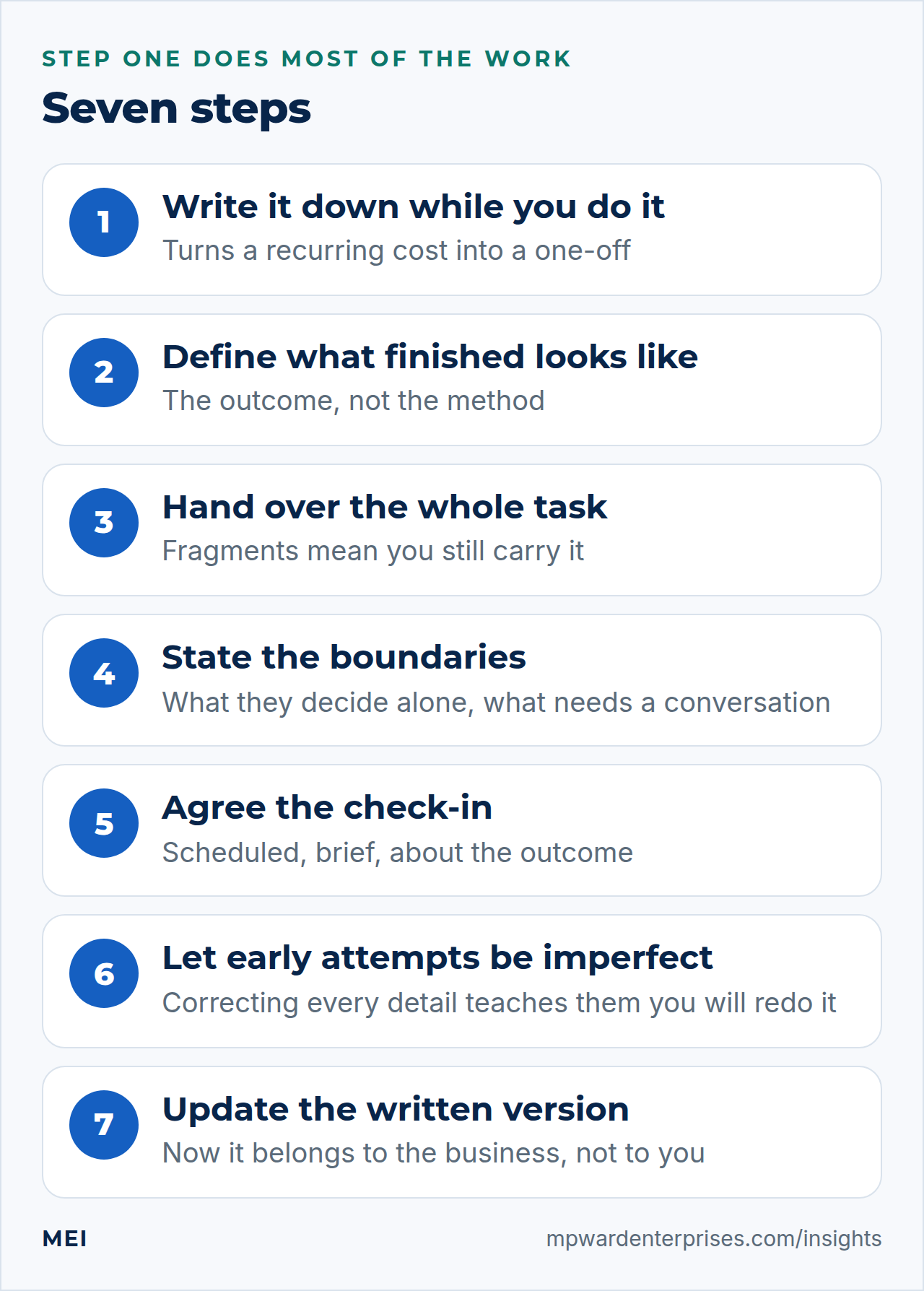
- Write it down while you do it. Next time the task comes round, record the steps as you work — notes, screenshots, or narrate it into your phone. This converts "explaining takes longer" from a recurring cost into a one-off.
- Define what finished looks like. Not the method — the outcome. What a good result contains, when it is due, who sees it.
- Hand over the whole task, not fragments. Delegating pieces while keeping the decision means you still carry it. Give someone the outcome and the authority to reach it.
- State the boundaries explicitly. What they can decide alone, what needs a conversation, what spending is approved. Unclear authority is the main reason work comes back for approval constantly.
- Agree how you will check in. Scheduled, brief, and on the outcome. This is what replaces looking over a shoulder.
- Let the first attempts be imperfect. If you correct every detail, you have taught them that you will redo it, and you will be doing it again within a month.
- Update the written version. When they find a better way — and they will — the document changes. Now it belongs to the business rather than to you.
The write-it-down step is the whole thing
If you only take one step from this, take the first. Almost every obstacle to delegation for small business owners dissolves once the task exists outside your head.
It does not need to be a polished procedure. A numbered list of steps, the logins needed, the two things that usually go wrong, and an example of a good result covers the great majority of routine work. Fifteen minutes while doing the task is enough.
The side effects are larger than the delegation itself. A written process can be improved, because it can be seen. It survives the person leaving. It makes holidays possible. And it is the raw material for deciding what to automate later — which is where business process automation starts, and why documenting business processes pays back far beyond this one use.
When it comes back wrong
It will, early on. How you respond in the first few instances determines whether delegation holds or quietly reverses.
First, decide honestly whether it is actually wrong or merely different. Owners frequently correct work that reached a perfectly good outcome by an unfamiliar route, which teaches people to stop thinking. If the result is acceptable, accept it.
If it genuinely is wrong, work out which of three causes applies: the instructions were incomplete, the boundaries were unclear, or the person lacks a skill. The first two are yours to fix and are by far the most common. Only the third is about the person, and it is usually solvable with one specific piece of teaching.
Then fix the written version rather than fixing the output yourself. Taking the task back is the single most common way delegation dies, and it almost always happens with good intentions and a deadline.
Three things not to delegate
- Key relationships. Your most important customers and suppliers should still hear from you. Delegate the administration around them, not the relationship itself.
- Deciding what the business is for. Direction, values, what you will and will not do. Nobody can hold this but you.
- The final word on money and risk. Day-to-day spending within a stated limit, yes. The decisions that could end the business, no.
Everything else is available. Owners tend to assume the protected list is much longer than it is, and in practice most of what feels undelegatable is simply undocumented.
If there is nobody to delegate to
This is the honest objection in a very small business, and it has three real answers.
Delegate outside the business. Bookkeeping, payroll, IT, marketing administration and scheduling are all routinely handled by specialists at a fraction of a salary, and the decision rule is the same: if someone else does it better and your time is worth more elsewhere, the arithmetic works. If you are weighing a contractor against an employee, the IRS publishes the rules distinguishing the two, which is worth reading before you commit.
Delegate to software for the genuinely repetitive parts, which is what automation is for.
And delegate upward in time: write the process now, so that when you do hire, the first week is productive rather than spent extracting knowledge from you under pressure. That documentation is also what makes the business valuable to anyone else, which matters for succession planning.
The resilience argument
Delegation is usually discussed as a productivity question. The more important case is continuity: a business where only one person can do several essential things has a single point of failure, and that person is you.
Illness, family emergencies and simple burnout all produce the same outcome — the work stops. Ready.gov's continuity planning material treats key-person dependency as a risk to plan for in exactly the way you would plan for a flood or a failed server, because the business consequence is identical.
Seen that way, every delegated and documented task is a reduction in risk as well as a return of hours. It is also, not incidentally, one of the reliable routes away from the pattern described in small business owner burnout.
Starting this week
Pick one frequent, routine task you will do in the next few days. Write it down as you do it — fifteen minutes, rough notes. Hand it over with a clear outcome, explicit boundaries and a scheduled check-in. Then do not take it back.
That is one task and perhaps an hour of effort. Repeat monthly and within a year the business runs on written processes rather than on your memory, which is the actual goal of delegation for small business owners. If the next step is removing the task entirely rather than handing it on, that is AI & Business Automation, and a Business Tech Rescue Audit will show where your time is currently going.
Frequently asked questions
Why is delegation so hard for small business owners?
Because the work accumulated into a shape that only makes sense from inside your head. The task has no written form, so handing it over means inventing one; you are genuinely faster at it, so each individual instance is quicker to just do; and the first few attempts by someone else will be worse. All three are real. They are reasons to treat delegation as an investment with a payback period, not reasons to avoid it.
What should a small business owner delegate first?
Frequent, routine, rule-based work — explaining it once pays back every week. Then work you are bad at or dislike, because someone else is faster and the output is better, and you are probably doing it late and badly already. Work needing judgement can be delegated gradually with review. Rare and complex work comes last, since explaining it costs more than it saves. Relationships, direction and major risk decisions stay with you.
What do I do when delegated work comes back wrong?
First decide honestly whether it is wrong or merely different — correcting work that reached a good outcome by an unfamiliar route teaches people to stop thinking. If it is genuinely wrong, identify which of three causes applies: incomplete instructions, unclear boundaries, or a missing skill. The first two are yours to fix and are by far the most common. Then update the written process rather than redoing the work yourself.
What should an owner never delegate?
Three things. Key customer and supplier relationships — delegate the administration around them, not the relationship. Deciding what the business is for: direction, values, what you will and will not do. And the final word on money and risk, meaning the decisions that could end the business, though day-to-day spending within a stated limit should certainly be delegated. Everything else is available, and most of what feels protected is just undocumented.
How do I delegate when I have no staff?
Three options. Delegate outside the business — bookkeeping, payroll, IT, marketing administration and scheduling are routinely handled by specialists for a fraction of a salary. Delegate to software for genuinely repetitive work. And delegate forward in time by writing the process now, so that when you do hire, the first week is productive rather than spent extracting knowledge from you under pressure.
How does delegation reduce business risk?
A business where only one person can perform several essential tasks has a single point of failure, and in a small business that person is the owner. Illness, a family emergency or burnout all produce the same result: the work stops. Continuity planning treats key-person dependency as a risk to plan for in the same way as a flood or a failed server, because the business consequence is identical. Every documented, delegated task reduces that exposure.
Sources and further reading
- U.S. Small Business Administration: Business Guide — managing and growing a business, including hiring and working with outside specialists
- Ready.gov: Business — continuity planning, where key-person dependency is treated as a risk alongside physical ones
- IRS: Small Businesses and Self-Employed — the rules distinguishing contractors from employees, worth reading before delegating outside the business