

Small business succession planning is usually imagined as a retirement document — something to write at sixty. The more useful framing is that it answers a question you already face today: what happens to this business if you are not here next month? Whether that absence is a sale, an illness or something worse, the preparation is largely identical, and most of it makes the business better to run in the meantime.
This guide covers the seven steps, the three exit routes and what each requires, the documents that have to exist, and why the work that makes a business sellable is the same work that makes it survivable.
Why this is not a retirement topic
Most owners defer small business succession planning because they associate it with leaving. But the single biggest risk to a small business is not the owner's eventual retirement — it is the owner's unplanned absence, and that risk exists at every age.
Continuity planning guidance treats key-person dependency as a hazard in exactly the same category as fire or flood, because the business consequence is identical: the work stops. The difference is that most businesses insure against fire and not against this.
The practical reframing is that small business succession planning and continuity planning are the same project viewed over different timescales. Preparing for a month's absence is most of the preparation for a permanent one, and the intermediate state — a business that runs without you for a fortnight — is worth having regardless of whether you ever sell.
The three succession routes out
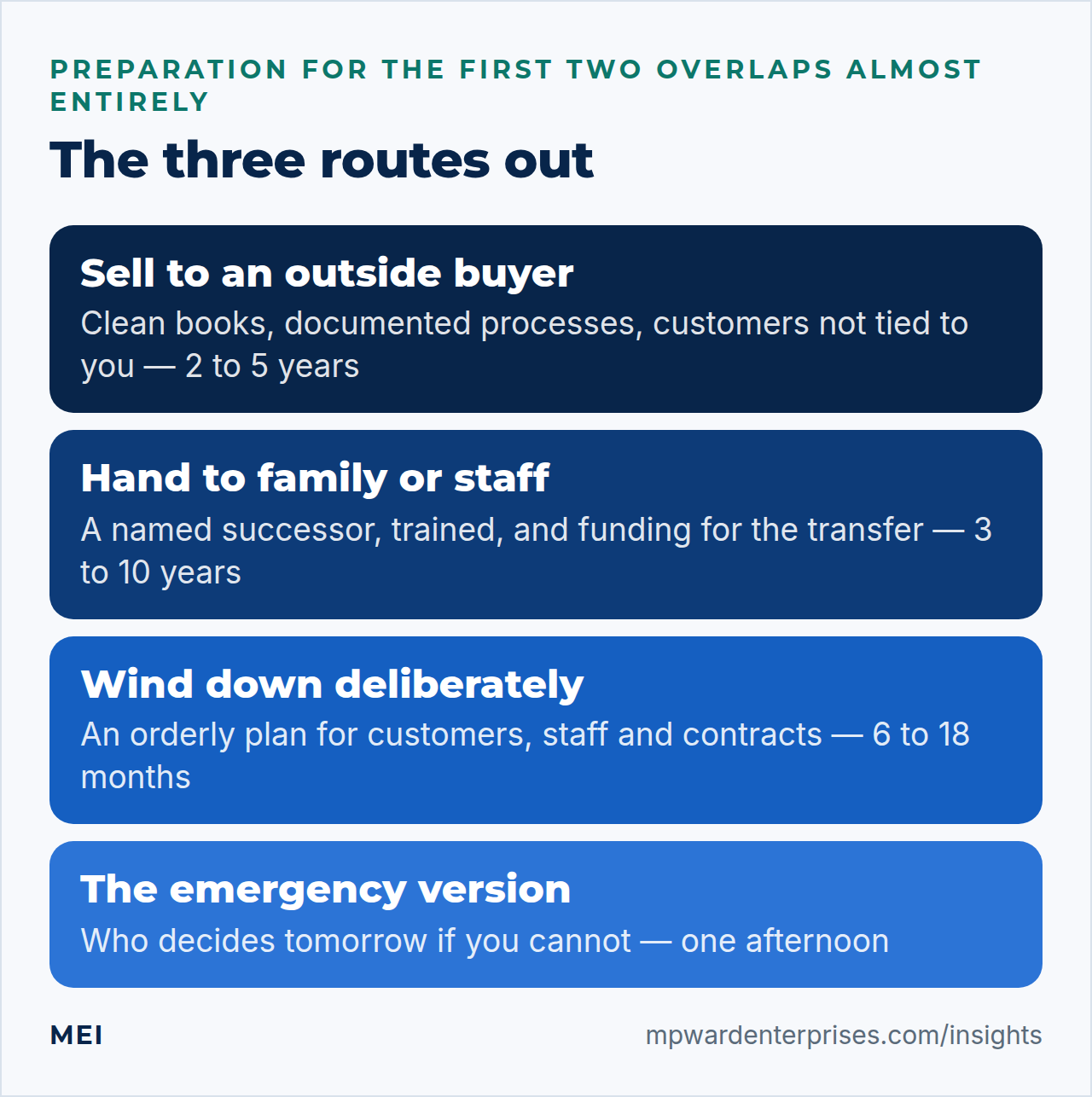
| Route | What it needs | Lead time |
|---|---|---|
| Sell to an outside buyer | Clean books, documented processes, customers not tied to you personally | 2 to 5 years |
| Hand to family or staff | A named successor, trained deliberately, and funding for the transfer | 3 to 10 years |
| Wind down | An orderly plan for customers, staff, contracts and assets | 6 to 18 months |
The third is a legitimate choice and rarely planned, which is why it so often happens badly and at the worst moment. A business that closes deliberately protects its customers, its staff and its owner's reputation; one that stops abruptly does none of those things.
You do not have to pick now. You do have to know which routes remain open, because the preparation for the first two overlaps almost entirely, and neglecting it quietly closes both.
Small business succession planning: the seven steps
- Write down what only you know. Supplier terms, pricing logic, the customer history, the reason things are done a particular way. This is the first step and the one that matters most.
- Remove yourself from daily operations. Not entirely — but a business that cannot run a fortnight without you cannot be sold or handed over, because what is being transferred is a job rather than an asset.
- Make the finances legible. Clean, separate, consistent records. An owner's expenses running through the business is normal and must be identifiable, or every figure becomes negotiable.
- Transfer relationships deliberately. Introduce key customers and suppliers to whoever else will hold them. This takes years and cannot be compressed.
- Secure the assets in the business's name. Domains, software accounts, intellectual property, equipment. Anything registered to you personally is a complication at best.
- Decide and document the emergency version. Who makes decisions tomorrow if you cannot. Who has access to what. Who to contact. This is the part with the shortest lead time and the highest urgency.
- Take advice early. Accountant and lawyer, well before a transaction. Structure and tax decisions made years ahead have far better options than those made in a hurry.
The emergency succession plan you can write this month
Everything above takes years. This part takes an afternoon and covers the risk that is actually present today.
Write one document, kept with your personal papers and with one trusted person, answering five questions. Who has authority to make decisions and spend money in your absence. Where the critical credentials are — not the passwords themselves, but where to find them and who can authorise access. Which three customers and three suppliers must be contacted immediately, with names and numbers. What the business's immediate obligations are: payroll, contracts, deadlines. And who to call for professional help — accountant, lawyer, bank, IT.
Two practical notes. The credentials question is solved by a password manager with documented emergency access rather than by a sealed envelope that goes stale, which is covered in password manager for small business. And this document must not live only in the systems it grants access to, which is the same mistake as storing a recovery plan on the server it describes.
What makes a small business sellable
Buyers pay for predictable future profit with manageable risk. Four things move that assessment more than anything else, and all four take time.
- It runs without the owner. The single largest factor. A business dependent on one person is buying that person a job, and is priced accordingly.
- Customers belong to the business. Contracts, recurring revenue, a concentration that is not dangerous. A buyer discounts heavily for customers who follow you out of the door.
- Documented processes. Evidence that the business can be operated by someone else, which is exactly what documenting business processes produces.
- Clean records. Finances, contracts, licences, employment arrangements. Every unresolved question becomes a price reduction or a condition.
Notice that every item on that list also makes the business easier and less stressful to own right now. That is the honest argument for starting: the preparation is not deferred benefit, it is immediate relief that happens to also be an exit plan.
If the successor is family or staff
Internal succession planning has a different shape from a sale, and a longer runway.
Internal succession fails on two things far more often than on capability.
The first is funding. The successor usually cannot simply buy the business, so the transfer needs a structure — earn-out, instalments, external finance, or a gradual transfer of shares. That is a conversation for your accountant years in advance, not months.
The second is the handover itself. Announcing a successor is not the same as preparing one. They need real authority before you leave, visible support in front of customers and staff, and the latitude to make decisions you would have made differently. Owners who stay involved "just to help" routinely undermine the person they chose, usually without intending to.
Agree a date and a defined role afterwards — consultant for a year, then out. Ambiguity about whether you have actually gone is the most common reason internal succession fails in the first two years.
Six succession planning mistakes
- Starting too late. The preparation that raises value takes two to five years. Starting at the point of sale means selling at a discount.
- Confusing a plan with a conversation. "The kids will take over" is an assumption until someone has asked them and written it down.
- Assets held personally. Domains, software accounts and intellectual property registered to you rather than the business.
- No emergency version. A twenty-year plan and no answer for next Tuesday.
- Hiding it from staff. Uncertainty is worse than news. People leave during ambiguity.
- Never writing anything down. A plan that exists only in the owner's head has the same failure mode as everything else that does.
Starting this week
Write the emergency document. One afternoon, five questions, two copies. That single step converts the most urgent and least-planned risk your business carries into something manageable, whatever your age and whatever you eventually decide.
Then begin the slower work: one documented process a week, and an honest look at which parts of the business only function because you are in them. Small business succession planning is mostly that — the steady removal of single points of failure, of which you are the largest. The related pieces are in business continuity planning and delegation.
On the technical side, a Business Tech Rescue Audit produces exactly the asset and access inventory this requires — what the business runs on, who controls it, and what is still registered in your own name rather than the company's.
Frequently asked questions
When should a small business owner start succession planning?
Now, in two parts. The emergency version — who decides and who has access if you are suddenly unavailable — takes an afternoon and addresses a risk that exists at every age. The longer preparation that raises a business's value takes two to five years for a sale and three to ten for an internal handover, so starting at the point you want to leave means leaving at a discount.
What are the options for exiting a small business?
Three. Sell to an outside buyer, which needs clean books, documented processes and customers not personally tied to you — typically two to five years of preparation. Hand to family or staff, which needs a named successor trained deliberately and a funding structure for the transfer. Or wind down deliberately, which is a legitimate choice, rarely planned, and therefore often done badly at the worst moment.
What should be in an emergency succession plan?
Five answers in one document, kept with your personal papers and with one trusted person. Who has authority to make decisions and spend money. Where critical credentials are — not the passwords, but where to find them and who can authorise access. Which three customers and three suppliers must be contacted immediately, with names and numbers. The business's immediate obligations: payroll, contracts, deadlines. And who to call for help: accountant, lawyer, bank, IT.
What makes a small business more valuable to a buyer?
Four things, all of which take time. That it runs without the owner, which is the single largest factor — a business dependent on one person is selling that person's job and is priced accordingly. Customers who belong to the business rather than to you personally. Documented processes, as evidence someone else can operate it. And clean records, since every unresolved question becomes a price reduction or a condition of sale.
Why does handing a business to family or staff often go wrong?
Two reasons, and neither is capability. Funding: the successor usually cannot simply buy the business, so the transfer needs a structure — earn-out, instalments, finance or a gradual share transfer — which is an accountant conversation years ahead. And handover: announcing a successor is not preparing one. They need real authority before you leave and visible support in front of customers, and owners who stay involved "just to help" routinely undermine the person they chose.
Is succession planning the same as business continuity planning?
Largely, viewed over different timescales. Preparing for a month's unplanned absence is most of the preparation for a permanent one: documented processes, assets held in the business's name, decisions that do not require you, and relationships held by more than one person. The intermediate state — a business that runs without you for a fortnight — is worth having whether or not you ever sell.
Sources and further reading
- U.S. Small Business Administration: Business Guide — guidance on closing, selling or transferring ownership of a business
- Ready.gov: Business — continuity planning, where key-person dependency sits alongside physical hazards
- IRS: Small Businesses and Self-Employed — the tax and structure considerations that have better options when decided years ahead