

Small business website cost is one of the hardest numbers to pin down, because the same three words — "a new website" — can mean a five-page brochure site or a booking system that takes payments. This guide gives the ranges we actually see quoted in 2026, explains what sits inside each band, and shows the five factors that move small business website cost more than anything else.
Most agencies hide website cost behind a contact form, which leaves owners guessing whether $2,000 is a bargain or $20,000 is a rip-off. Both can be fair. The difference is scope, and scope is something you can learn to read. Below you will find the bands, the running costs that rarely appear in a proposal, the red flags worth walking away from, and a short brief you can send to three suppliers to get comparable quotes.
Small business website cost at a glance
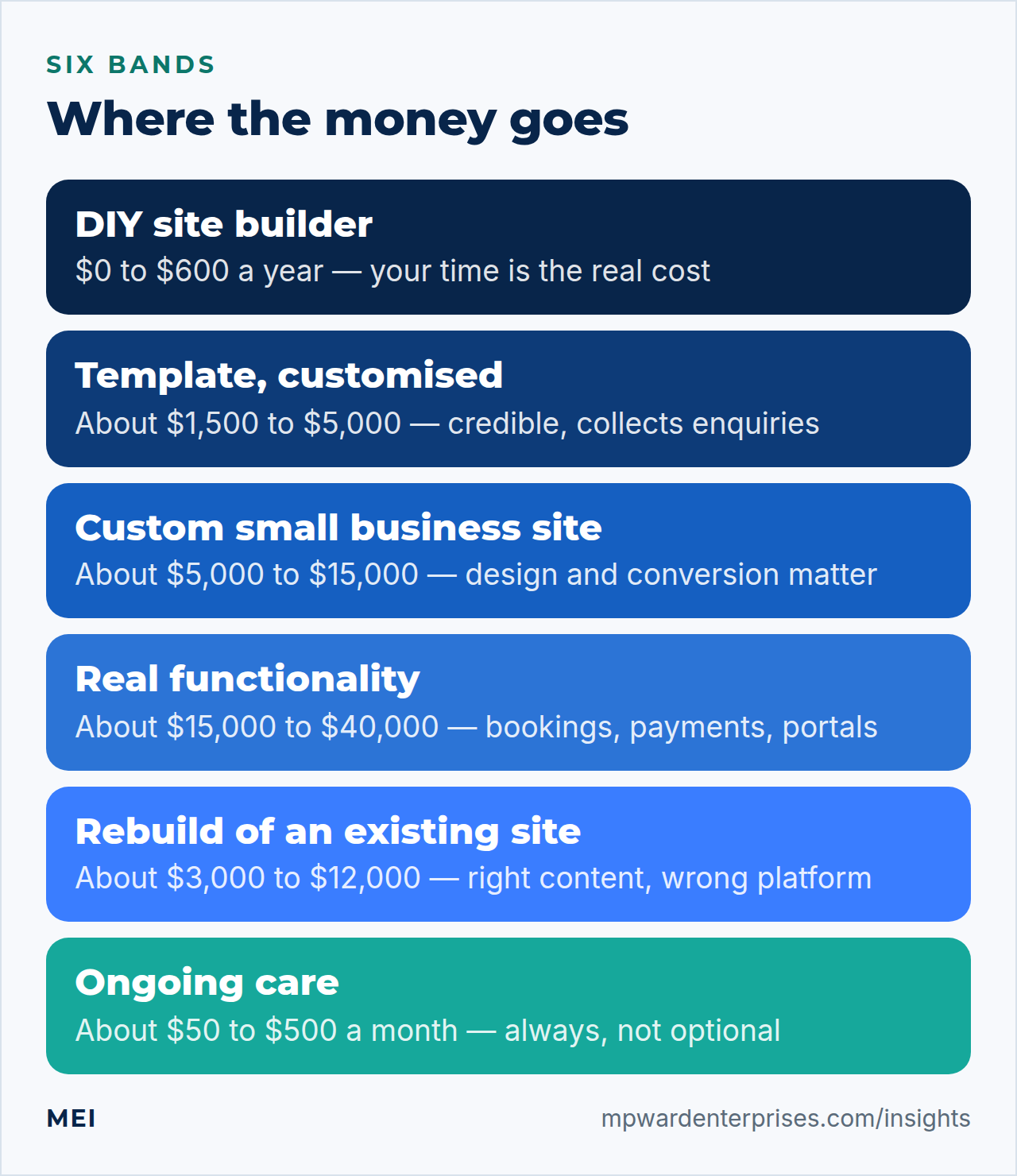
These are the small business website cost ranges we see in the market for a professionally built small business website in 2026. They are ranges, not quotes: a real number comes only after someone has looked at your content, your integrations and the state of what you have now.
| What you are buying | Typical range | Fits when |
|---|---|---|
| DIY on a site builder | $0 to $600 a year | You have time, simple needs and no integrations |
| Template site, lightly customised | About $1,500 to $5,000 | You need to look credible and collect enquiries |
| Custom small business site | About $5,000 to $15,000 | Design, content and conversion matter to revenue |
| Site with real functionality | About $15,000 to $40,000 | Bookings, payments, portals, or a CRM to feed |
| Rebuild of an existing site | About $3,000 to $12,000 | The content is broadly right but the platform is not |
| Ongoing care after launch | About $50 to $500 a month | Always. A site is not a one-off purchase |
Two sites can sit at opposite ends of that table and look almost identical to a visitor. The money goes into things visitors never see directly: the research behind the page order, the speed work, the accessibility pass, the integrations, and whether anyone will still be answering the phone in eighteen months.
What you are actually paying for
A website quote is mostly labour. Understanding how that labour divides makes a proposal much easier to read, and makes it obvious when two quotes are not describing the same job.
- Discovery and strategy. Who the site is for, what you want them to do, and what the pages need to say to get them to do it. Skipped on cheap projects, and the usual reason a pretty site produces no enquiries.
- Design. Layout, typography, colour and the component set. A template reduces this to configuration; a custom design multiplies it.
- Content. Writing, editing, photography. The single most common cause of a stalled project is a client who agreed to supply copy and then could not.
- Build. Turning the design into pages that work on a phone, load quickly and can be edited by a non-technical person.
- Integrations. Payments, bookings, CRM, email marketing, accounting. Each one is a small project with its own testing.
- Launch and handover. Redirects, analytics, search console, training, documentation. Cheap to do properly, expensive to repair.
The five things that move small business website cost
When a website quote comes in far above or below what you expected, it is almost always one of these five, not the designer's hourly rate.
- Page count and content readiness. Ten pages of supplied, final copy is a different job from "about twenty pages, we'll write them as we go". Unwritten content is the most expensive thing in any proposal because it stops the clock.
- Custom versus template. A good template, configured well, is not a compromise for most businesses. Custom design earns its cost when your brand is the product or your layout has to do something unusual.
- Functionality. A contact form is free. A booking calendar that checks staff availability, takes a deposit and syncs to a calendar is a fortnight of work and a permanent maintenance obligation.
- Migration and legacy mess. Moving two hundred posts, preserving URLs and fixing years of accumulated plugins costs more than starting clean. It is also usually the right call, because those URLs carry your rankings.
- Who carries the risk. A fixed quote means the supplier absorbs the overruns, and prices that in. Time and materials is cheaper on paper and riskier in practice.
Who builds it: DIY, freelancer, agency or specialist
The same small business website costs wildly different amounts depending on who builds it, and the cheapest option is not always the one that costs least over three years.
| Option | Typical cost | The real trade-off |
|---|---|---|
| Do it yourself | $0 to $600 a year | Your time is the cost. Fine for a simple site; painful once you need anything custom |
| Freelancer | $1,500 to $8,000 | Good value and direct contact, but a single point of failure when they move on |
| Agency | $8,000 to $40,000+ | Breadth and process, with account management included in the price whether you need it or not |
| Independent specialist | $3,000 to $20,000 | Agency-level work without the overhead; capacity is the constraint |
Ask every candidate the same question: what happens in two years when something breaks and the person who built it is unavailable? The answer tells you whether you are buying a website or renting a dependency. A site built on standard WordPress with documented decisions can be picked up by anyone. A site built on a proprietary platform cannot.
The running costs nobody puts in the quote
The build is the smaller part of small business website cost over a site's life. These are the costs that continue, and leaving them out of your budget is how a successful launch turns into a neglected site two years later.
- Hosting: $10 to $100 a month for a small business website. The cheapest shared hosting is usually a false economy, as we cover in VPS vs shared hosting.
- Domain and certificates: $15 to $50 a year. Certificates should be free and automatic; if you are being billed hundreds for SSL, ask why.
- Licences: $200 to $800 a year for premium themes and plugins. Real, recurring, and routinely forgotten at budget time.
- Maintenance: $50 to $500 a month for updates, backups, monitoring and fixes. Our WordPress maintenance checklist sets out what that work actually involves.
- Content and changes: whatever you budget, plus the hours someone in your business spends. A site nobody updates stops earning.
Add those up and a $6,000 site is really $6,000 plus perhaps $2,400 a year. That is not a reason to spend less on the build. It is a reason to spend it on something maintainable.
Rebuild or repair? A simple test
Plenty of businesses pay full small business website cost for a rebuild when a fortnight of repair would have done, and plenty limp along on a site that should have been replaced two years ago. A short test separates them.
Rebuild when the platform is the problem: the site cannot be edited without breaking, it is not usable on a phone, it is built on something unsupported, or it has been compromised. Repair when the structure is sound but the symptoms are specific — slow pages, a broken form, poor rankings. Those have targeted fixes, and we work through the most common ones in why is my WordPress site so slow.
If you are not sure which side you are on, that is itself the finding, and it is worth an hour of someone's time before it is worth five figures of your budget.
Red flags in a website quote
Most bad website projects were predictable from the website quote. These are the signals worth taking seriously.
- No discovery. A fixed price offered before anyone has asked what the site is for is a price for a template, whatever the covering note says.
- You do not own it. Check in writing who owns the domain, the hosting account, the content and the design files. If you cannot leave, the price is not the price.
- Proprietary platform with no export. Cheap monthly builds that cannot be moved are rented, not bought.
- Nothing about speed or accessibility. Both are measurable and both affect revenue; silence usually means neither was planned.
- "Unlimited" anything. Unlimited revisions means the scope is undefined, which protects nobody.
- No maintenance conversation. A supplier who does not raise what happens after launch has not thought about what happens after launch.
How to brief a project so your website quotes are comparable
You do not need a technical specification. You need enough shared detail that three suppliers price the same job. Send all of them the same page covering these points.
- What the site is for. One sentence: enquiries, bookings, online sales, credibility.
- How you will know it worked. A number, even a rough one. "Twenty enquiries a month" changes the design.
- Your pages. A list, marked for which content exists and which has to be written.
- Must-have integrations. Named tools, not categories: which CRM, which payment provider, which calendar.
- What happens to the old site. How many pages, and whether the URLs need to carry over.
- Budget range and date. Withholding the budget does not get you a better price; it gets you proposals you cannot compare.
What a realistic small business website cost looks like
Some worked small business website cost examples, in the shape most small businesses actually arrive in.
| Business | What they need | Sensible budget |
|---|---|---|
| Trades business, 3 staff | Six pages, enquiry form, service areas, reviews | $2,500 to $5,000 build, $75 a month after |
| Professional practice | Twelve pages, team profiles, booking, newsletter | $6,000 to $12,000 build, $150 a month after |
| Retailer moving online | Catalogue, payments, shipping, stock sync | $12,000 to $30,000 build, $250+ a month after |
| Established site, wrong platform | Rebuild, migrate 150 pages, keep rankings | $5,000 to $12,000, plus care |
Notice that the monthly figure scales with the build. More moving parts mean more to keep working. If a supplier quotes you a complex site and a trivial care plan, one of the two numbers is wrong.
Two things worth paying for, whatever the budget
Whatever website cost band you land in, two line items repay their cost, and both are measurable rather than matters of taste.
The first is performance. Google publishes Core Web Vitals as a set of field measurements for loading, interactivity and visual stability, and they are part of how pages are assessed in search. More importantly, people leave slow sites. A build that is fast on a mid-range phone on mobile data is worth more than one that is fast on the designer's laptop.
The second is accessibility. The Web Content Accessibility Guidelines are the international reference, and meeting them well is mostly a set of decisions taken during design — colour contrast, focus states, labelled form fields, sensible heading order. Taken up front they cost very little. Retrofitted, they are a project of their own.
How we quote a website project
For transparency, here is how we arrive at a small business website cost, which is also a reasonable template for judging anyone else's website quote.
Work starts with discovery rather than a website cost: goals, a content review, a technical audit of the current site, and a written scope with a fixed quote at the end of it. A website rebuild begins with a $500 deposit that reserves the slot and is credited in full against the project total, so the discovery work is not a separate bill.
If you would rather find out what is wrong before committing to anything, the Business Tech Rescue Audit is $497 and produces a prioritised list you can take to any supplier, including one that is not us.
After launch, sites move onto Managed Website & IT Care, which starts at $149 a month. Where a project needs something that does not exist off the shelf, that is WordPress engineering and is quoted separately. The same logic applies to your IT spend more broadly, which we break down in small business IT support cost.
Frequently asked questions
How much does a website cost for a small business in 2026?
Most small businesses pay between $1,500 and $15,000 for a professionally built small business website. A lightly customised template site generally runs $1,500 to $5,000; a custom-designed site $5,000 to $15,000; and a site with bookings, payments or a customer portal $15,000 to $40,000 or more. On top of the build, expect roughly $50 to $500 a month for hosting, licences and maintenance. These are market ranges rather than quotes — real small business website cost depends on page count, how much content already exists, and which systems the site has to connect to.
Why are website quotes so different for the same job?
Usually because they are not the same job. One quote includes discovery, content, speed work, accessibility and a migration that preserves your URLs; another covers configuring a template with content you supply. Both can be honest. Send every supplier the same one-page brief — purpose, page list, which content exists, named integrations, what happens to the old site, and your budget range — and the quotes become comparable.
Is it cheaper to rebuild a website or fix the one I have?
Small business website cost favours repair when the structure is sound and the symptoms are specific: slow pages, a broken form, weak rankings. Rebuild when the platform itself is the problem — the site cannot be edited without breaking, it is unusable on a phone, it runs on something unsupported, or it has been compromised. A rebuild of an existing site typically runs $3,000 to $12,000, against a few hundred to a couple of thousand for targeted repairs.
What are the ongoing costs of a small business website?
Hosting is $10 to $100 a month, a domain $15 to $50 a year, premium themes and plugins $200 to $800 a year, and maintenance — updates, backups, monitoring and fixes — $50 to $500 a month depending on complexity. A $6,000 small business website is realistically $6,000 plus around $2,400 a year. MEI's Managed Website & IT Care starts at $149 a month.
Should I use a website builder instead of hiring someone?
If your needs are genuinely simple, you have time, and you need no integrations, a site builder at $0 to $600 a year is a reasonable answer. It stops being reasonable once you need custom functionality, a migration that preserves rankings, or a site that someone else can take over. The usual hidden website cost is your own hours, which rarely appear in the comparison.
How long does a small business website take to build?
A template site with supplied content takes two to four weeks. A custom site is typically six to twelve weeks, and a site with bookings or payments longer, because each integration needs its own testing. The schedule almost always slips for the same reason the budget does: content that was going to be written and was not.
Sources and further reading
- web.dev: Core Web Vitals — Google's field measurements for loading, interactivity and visual stability, and how they are used to assess page experience
- W3C Web Accessibility Initiative: WCAG 2 Overview — the international accessibility standard; most of its cost is design-time decisions rather than later remediation
- WordPress.org: Requirements — the hosting baseline a standard WordPress build expects, useful when comparing hosting line items