
Root cause analysis for small business is the habit of asking why a problem happened until you reach a cause you can fix, so that it stops coming back. The simplest method is the 5 Whys: state the problem, ask "why?", check the answer against evidence, and repeat until the answer is something you can change. It works for a website that went down, a customer who left, an invoice that keeps being paid late. Used carelessly, it also fails in predictable ways, which this guide shows you how to avoid.
Most small businesses fix the symptom and move on. The form is repaired, the customer is apologized to, the late invoice is chased. Then the same problem returns next month and costs more. A little structure turns a recurring annoyance into a one-time fix. Below you will find the method, two worked examples, a one-page template and the traps to watch for.
What is root cause analysis for small business?
A root cause is the underlying reason a problem happened, the one that, if you fixed it, would stop the problem recurring. A symptom is what you see. The Institute for Healthcare Improvement, which teaches the 5 Whys to quality teams, puts the distinction in a sentence: what we think is the cause is sometimes just another symptom. A broken contact form is a symptom. Why it broke, and why nobody noticed for nine days, is where the cause lives.
Root cause analysis (RCA) is any structured way of getting from symptom to cause. The two most useful tools for a small business are the 5 Whys, which follows one chain of reasoning, and the fishbone diagram, which maps many possible causes at once. Neither requires software or training, only honesty and evidence.
When root cause analysis is worth doing
- The same problem has happened more than once.
- The problem was expensive, embarrassing or dangerous, even once.
- A near miss happened, where you were lucky.
- Different people give different explanations of what went wrong.
- A fix was applied, but you do not know why it worked.
Do not run a full analysis on every small hiccup. A typo in an email does not need a meeting. Save the effort for problems that recur or hurt.
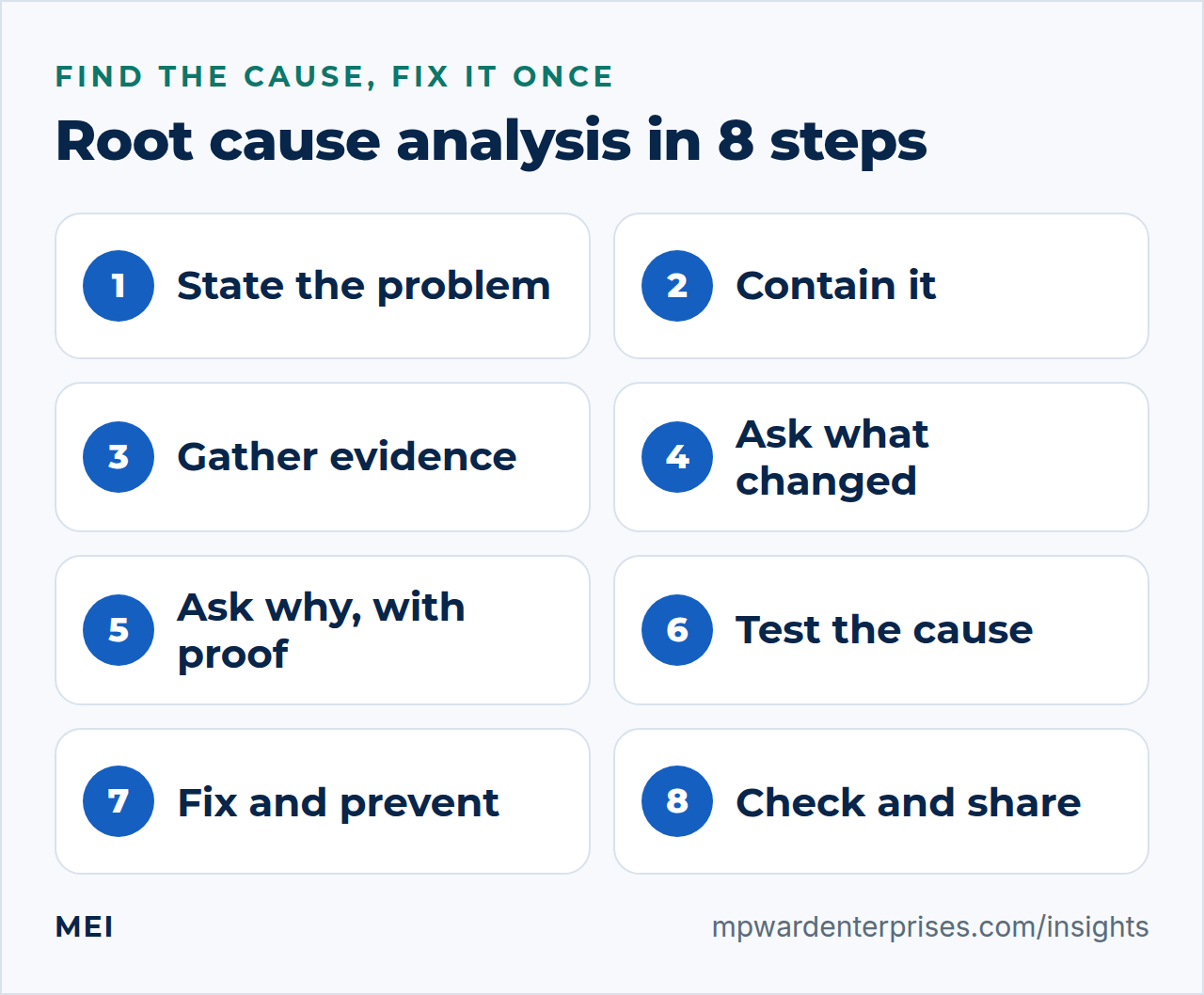
Root cause analysis in 8 simple steps
- State the problem precisely.What happened, to what, when and how big? "Quote requests stopped arriving for nine days" beats "the website is broken".
- Contain it.Stop the damage first. Fix or work around the symptom so customers are protected while you investigate.
- Gather the evidence and build a timeline.Logs, error messages, screenshots, emails, who did what and when. Evidence stops the discussion becoming opinion.
- Ask what changed.Most failures follow a change: an update, a new vendor, a new hire, a new setting. List changes before the problem began.
- Ask why, with evidence at every step.Use the 5 Whys, or a fishbone diagram if there may be several causes. Each answer must be something you can show.
- Test the cause.If this is the cause, what else must be true? Check it, and ask whether fixing it would have prevented the problem.
- Fix the cause and prevent the repeat.Write one corrective action and one preventive action, each with an owner and a date.
- Check that it worked and share what you learned.Look again in a month. Tell the team what happened, without blame.
How the 5 Whys works
The 5 Whys is attributed to Taiichi Ohno, the father of the Toyota Production System, and is taught by the IHI as a simple way to find the root cause: when a problem presents itself, ask why it happened, then ask why again, until you reach the cause. Five is a guide, not a rule. Stop when you reach something you can act on and that, if fixed, would prevent the problem.
Worked example 1: leads stopped arriving
This is an illustrative composite, based on a pattern common in email delivery problems. It shows the shape of a good analysis.
| Question | Answer, and the evidence |
|---|---|
| Problem | No quote requests by email for nine days; the form plugin's log shows 14 entries |
| Why 1: Why did the emails not arrive? | The receiving provider rejected them (bounce messages in the sending log) |
| Why 2: Why were they rejected? | They failed authentication: the site sends mail as the company's domain through the web host, and the domain's policy rejects mail that fails the checks |
| Why 3: Why did they fail now? | The host moved the site to new mail servers last month, and the approved sender list in DNS still named the old ones |
| Why 4: Why did nobody notice? | There is no test message and no alert when a form fails to deliver; the first sign was the phone not ringing |
| Why 5: Why was there no check after the move? | Nobody owns email delivery, and changes to hosting or DNS are not followed by a checklist |
The root causes here are a missing owner and a missing check, not a bad plugin. The corrective action is to fix the DNS records and send form mail through an authenticated service. The preventive actions are a weekly form test, an alert on failed delivery, a named owner and a checklist for any hosting change. Our guides to WordPress contact forms not sending email and SPF, DKIM and DMARC explain the technical side.
Worked example 2: invoices keep being paid late
| Question | Answer, and the evidence |
|---|---|
| Problem | 40 percent of invoices are paid more than 30 days late; cash is tight every month |
| Why 1 | Customers do not pay until chased (payment records) |
| Why 2 | Invoices go out days after the job, and many go to a general mailbox (invoice dates, delivery log) |
| Why 3 | Invoicing is done in a batch at month end by whoever has time |
| Why 4 | No one owns invoicing, and the job-complete step does not trigger it |
| Why 5 | The process was never designed; it grew by habit as the business grew |
The fix is a designed process: invoice when the job is marked complete, send it to the named payer, add a payment link and automate reminders. The same answer would be "chase harder" if you stopped at the first why, and chasing harder would not have fixed anything.
When to use a fishbone diagram instead
The IHI describes a cause and effect, or fishbone, diagram as a graphic tool used to explore and display the possible causes of a certain effect. It helps a team see that many causes contribute to an effect and how they relate. You write the problem at the head of a fish and draw bones for categories of cause. The classic categories are materials, methods, equipment, environment and people. For an IT or service problem, these adapt well.
| Category | Questions to ask |
|---|---|
| People | Did the people involved have the training, access and time? Was anyone unsure who owned it? |
| Process | Is there a written procedure? Was it followed? Where did it have gaps? |
| Technology | What systems were involved? What changed, failed or was out of date? |
| Suppliers and partners | Did a vendor change something, fail or give poor information? |
| Environment | Did load, timing, season or an outside event play a part? |
| Data and information | Was information wrong, missing or late? |
Use a fishbone when you suspect several causes, or when people disagree. Gather the team, brainstorm causes into the bones, then test the likeliest ones with evidence, and finish with a 5 Whys on each real cause.
Where the 5 Whys goes wrong
Used carelessly, the 5 Whys can mislead. The AHRQ's Patient Safety Network, in a perspective on rethinking root cause analysis, warns that asking why repeatedly is oversimplified and may inappropriately lead to a single root cause, possibly at the very end of the chain, missing causes further upstream. The IHI itself notes that there may be several root causes, and that people who see different parts of the system will answer differently. Watch for these traps.
- One chain only. Real problems have several contributing causes. Ask whether another chain exists.
- Stopping at a person. "Human error" and "Sam forgot" are not root causes. Ask what in the system made the error easy and the catch hard.
- Hindsight bias. Once you know the outcome, earlier decisions look obviously wrong. The same PSNet piece warns that this bias tends to simplify complex events and attribute blame when people's actions were not blameworthy.
- Answers without evidence. If a "because" cannot be shown, mark it as a guess and go and check.
- A fix that treats a symptom. "Add training" or "be more careful" rarely changes the system. Prefer changes that make the failure impossible or visible.
- Doing it alone. Include people who see different parts of the process.
Five tests for a real root cause
- Can you show evidence for it?
- If you removed it, would the problem have been prevented?
- Is it a process, system or decision rather than a person's character?
- Is it within your control to change?
- Does it explain the symptoms you saw, and not just some of them?
Make it blameless, or nobody will tell you the truth
If people expect punishment, they hide mistakes, and your analysis loses its best evidence. Google's engineering team, which writes widely about incident reviews, describes a blameless postmortem as one that focuses on identifying the contributing causes of the incident without indicting any individual or team, assuming that everyone involved had good intentions and did the right thing with the information they had. The goals are to document the incident, make sure the root causes are understood and put effective preventive actions in place.
That does not mean no accountability. Owners are accountable for completing the fixes. It means the question is "what allowed this?" rather than "who did this?". Leadership involvement matters too: AHRQ's primer notes that effective analysis needs active involvement of leadership, a focus on stronger systems-level solutions and measurement of implementation and results.
Root cause analysis in IT: evidence to collect
Technology problems leave traces, if you know where to look. Collect before you theorize, because logs rotate and memories fade.
- Exact error messages, screenshots and timestamps, with the time zone.
- The change history: updates, plugin and theme changes, DNS edits, new users, new software.
- Server, application and email logs around the first failure.
- DNS records now and, if available, before the change.
- Monitoring graphs and alerts, and the vendor's status page.
- Backup and restore logs, in case you need to roll back.
The usual suspects are worth testing first: for slowness, see why your WordPress site is slow; for mail, emails going to spam; for risk across the whole business, the IT audit checklist. NIST's small business guide builds the same discipline into incident response, asking you to assess an incident to determine its severity, what happened and its root cause.
A one-page root cause analysis template
PROBLEM (one sentence, with dates and size)

IMPACT (customers, money, time)

CONTAINMENT (what we did to stop the harm, and when)

TIMELINE (time | event | source of evidence)

WHAT CHANGED BEFORE IT STARTED?

WHY CHAIN(S) (each answer with its evidence)
  Why 1:
  Why 2:
  Why 3:
  ...

ROOT CAUSE(S) (process or system, in one sentence each)

CORRECTIVE ACTION (fixes this problem) | owner | date

PREVENTIVE ACTION (stops the next one) | owner | date

CHECK (how and when we will confirm it worked)

WHAT WE LEARNED (shared with the team)
A 30-minute root cause meeting
- Five minutes: the facts.Read the problem statement and the timeline. No theories yet.
- Ten minutes: causes.Brainstorm onto a fishbone or run the 5 Whys, asking for the evidence behind each answer.
- Five minutes: pick the root causes.Apply the five tests.
- Ten minutes: actions.Write one corrective and one preventive action, each with an owner and a date.
Getting a second pair of eyes
Some problems are hard to trace because they cross several systems: the page a visitor sees, the form they submit, the DNS that validates your domain, the server that answers and the inbox that should receive the message. That is what MEI's founder, Michael Ward, trained for, first as a master automotive technician diagnosing faults other shops sent away. The method, as his Meet Michael Ward page describes it, is to gather evidence, challenge assumptions, isolate the true root cause and fix it once instead of throwing parts at a symptom.
MEI's Business Tech Rescue Audit starts at $497. It examines your website, email, forms, hosting, security, backups and workflows together and ends with findings grouped by urgency, business impact and effort. When a problem has already cost you, the lessons feed straight into how to rebuild a business, and into your business continuity plan.
Frequently asked questions
What is root cause analysis?
Root cause analysis is a structured way of finding the underlying reason a problem happened, so that fixing it stops the problem from recurring. It separates the symptom you saw from the cause behind it, using evidence and tools such as the 5 Whys and the fishbone diagram.
What is the 5 Whys technique?
The 5 Whys is a simple method, attributed to Taiichi Ohno of Toyota, in which you ask why a problem happened, then ask why of each answer, until you reach a cause you can act on. Five is a guide rather than a rule. Each answer should be backed by evidence, not guesswork.
Is the 5 Whys enough for root cause analysis?
For simple, recurring problems it is a good start. For complex problems it can be oversimplified, leading to a single cause at the end of one chain and missing causes upstream. Combine it with a fishbone diagram, a timeline and the question "what changed?", involve people who see different parts of the process, and keep it blameless.
How do you do a simple root cause analysis?
State the problem precisely, contain it, gather evidence and a timeline, ask what changed, ask why with proof at each step, test the cause, write a corrective action and a preventive action with owners and dates, and check a month later that the fix held. A 30-minute meeting and a one-page template are enough for most small business problems.
What is a fishbone diagram?
A fishbone, or Ishikawa, diagram is a graphic tool for exploring the possible causes of an effect. You write the problem at the head of the fish and draw bones for categories of cause, such as people, process, technology, suppliers, environment and data. It helps a team see that many causes can contribute to one problem.
What is root cause analysis in IT?
It is the same method applied to technology failures: collect the exact errors and timestamps, list what changed before the failure, gather logs and DNS or configuration history, and ask why with evidence until you find a process or system cause. The fix should remove the cause and add a check, such as monitoring or a change checklist, so it is caught next time.
Sources and further reading
- Institute for Healthcare Improvement: 5 Whys, Finding the Root Cause — the technique, its attribution to Taiichi Ohno, symptoms versus causes, and multiple root causes
- Institute for Healthcare Improvement: Cause and Effect Diagram — the fishbone diagram, its uses and its classic categories
- AHRQ Patient Safety Network: Rethinking Root Cause Analysis — why the 5 Whys can be oversimplified, and the risks of hindsight bias and blame
- AHRQ Patient Safety Network: Root Cause Analysis (primer) — what effective analysis requires: leadership involvement, systems-level solutions and measurement
- Google SRE Book: Postmortem Culture: Learning from Failure — blameless postmortems and what a good one contains
- NIST SP 1300: Cybersecurity Framework 2.0 Small Business Quick-Start Guide — assessing an incident for its severity, what happened and its root cause (February 2024)