

How to choose a web designer comes down to eight questions, and none of them is about portfolios. Everyone's portfolio looks good — that is what a portfolio is for. The questions that predict whether you will be happy in two years are about ownership, maintenance, content, and what happens when the person who built it is unavailable.
This guide gives those eight questions, the answers worth hearing, the answers that should end the conversation, and a short brief that makes three quotes comparable. It is written from the perspective of someone who regularly inherits other people's websites.
How to choose a web designer: the eight questions
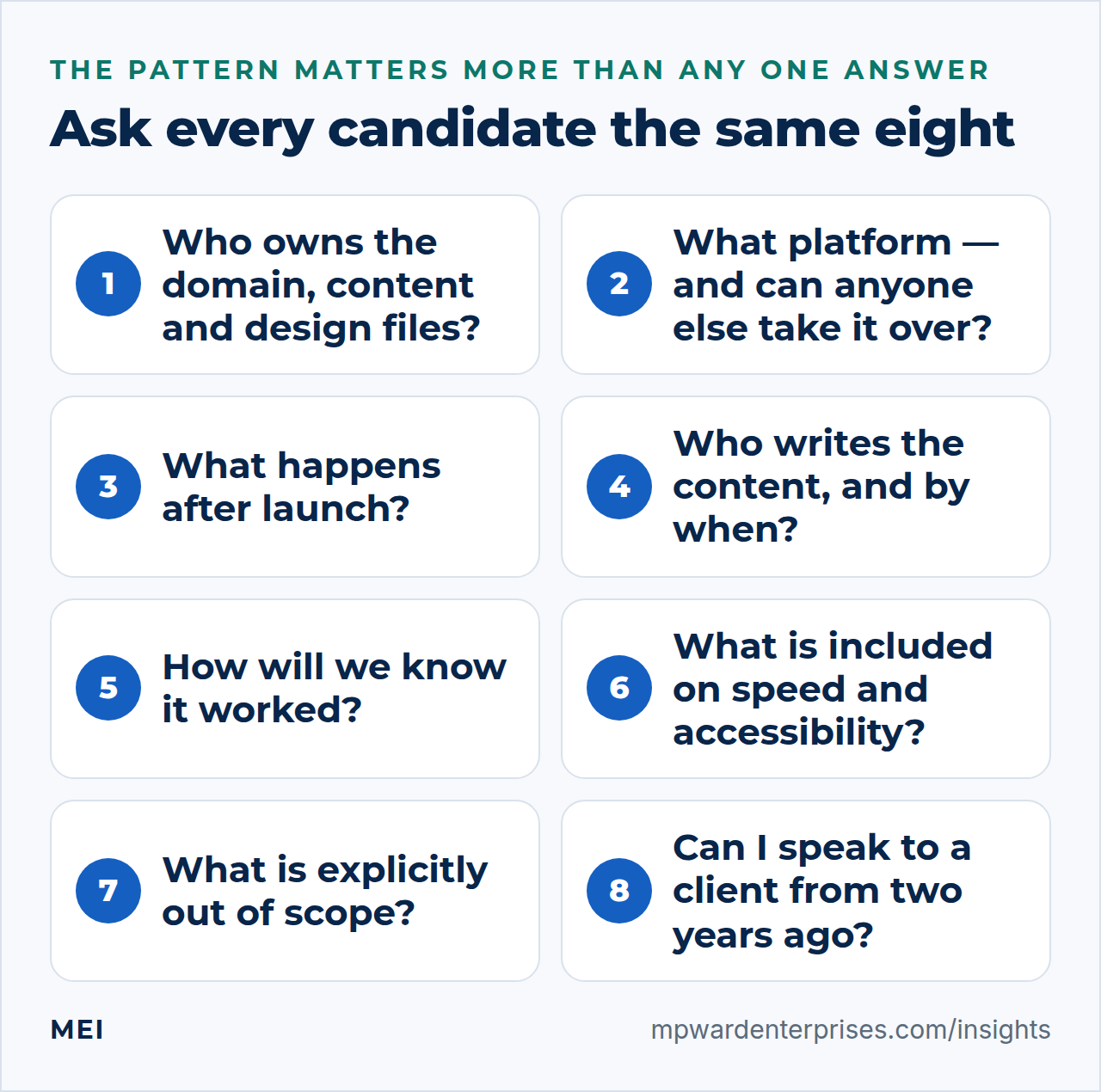
Ask every candidate the same eight. The pattern of the answers tells you more than any single response.
- "Who owns the domain, hosting, content and design files when we are finished?" The right answer is "you do, and here is how you get them". Anything vaguer is a hostage arrangement.
- "What platform will you build on, and can another developer take it over?" Standard WordPress, a documented framework, or anything with a real export. A proprietary builder only that web designer can edit is a long-term dependency.
- "What happens after launch?" You are listening for updates, backups, monitoring and a response time — and whether that is included, optional, or has simply not been considered.
- "Who writes the content?" The most common cause of a stalled web design project is content that was going to be supplied and never was. Get this in writing with dates.
- "How will we know it worked?" A good answer names a measurement — enquiries, bookings, calls. A weak one talks only about how it will look.
- "What is included on speed and accessibility?" Both are measurable. Silence usually means neither was planned, and retrofitting both is a project of its own.
- "What is out of scope?" A supplier who can describe the boundary has done this before. One who says "anything you need" has not quoted carefully.
- "Can I speak to a client from two years ago?" Not last month — two years. That is where you learn how they behave after the invoice is paid.
Why ownership decides how to choose a web designer
More small businesses are trapped by ownership than by bad web design. The pattern is familiar: a web designer registers the domain in their own account "to make it easier", hosts the site on their reseller plan, builds on a platform only they can edit, and bills monthly. Everything is fine until the relationship ends.
At that point the business discovers it cannot move the domain, cannot export the site, and cannot get the original image files. The leverage is total, and it is almost never malicious — it is usually just how things were set up, years earlier, without anyone thinking about the end.
Ask for three things in writing before any money changes hands: the domain registered in your own account with you as the registrant, administrative access to the hosting, and delivery of the design source files at handover. A professional will agree without hesitation, because they expect to keep your business by being good rather than by holding the keys.
Web designer answers that should end the conversation
- "We'll register the domain for you." On their account, with them as registrant. Register it yourself, today, before you hire anyone.
- "You can't move it, but you won't want to." A platform with no export is rented, not bought.
- "Unlimited revisions." Means the scope is undefined, which protects nobody and ends badly for both sides.
- A fixed price before any questions. A price quoted before anyone asked what the site is for is a price for a template.
- No mention of what happens after launch. Sites are not finished at launch; they are started.
- Vagueness about who writes the copy. The single most reliable predictor of a project that runs months late.
Freelancer, agency, or independent specialist
Part of how to choose a web designer is choosing what kind of supplier you want. Each shape has a predictable strength and a predictable risk.
| Type | Strength | Risk |
|---|---|---|
| Freelancer | Direct contact, good value, personal investment | One person — illness, holidays, moving on |
| Agency | Breadth, process, cover when someone leaves | You may be a small account; overhead is in the price |
| Independent specialist | Senior work without agency overhead | Capacity; the good ones are booked |
| Template service | Fast and cheap | Little strategy; you are buying configuration |
There is no best answer, only a fit. What matters is asking the continuity question directly: if you are unavailable for a month, what happens to my site? A good supplier of any size has thought about this and will tell you plainly.
A brief that makes quotes comparable
You cannot compare three proposals that answer three different questions. Send every web designer the same page covering six points, and the quotes become comparable without any technical knowledge on your part.
- What the site is for — enquiries, bookings, sales, credibility. One sentence.
- How you will measure success — a rough number is fine and changes the design.
- Your page list, marked for which content exists and which must be written.
- Named integrations — which CRM, which payment provider, which calendar. Not categories.
- What happens to the old site — how many pages, and whether URLs must carry over.
- Budget range and target date. Withholding the budget does not get a better price; it gets proposals you cannot compare.
The cost bands those quotes are likely to land in are set out in small business website cost, which is worth reading before you open the first proposal.
What the web design agreement should say
You do not need a long contract. You need five things written down, and most disputes we see involve one of them being absent.
- Ownership on payment — domain, content, design files, and administrative access.
- What is being delivered — a page count or a defined scope, with revisions bounded by number or by time.
- Who supplies what, by when — especially content, and what happens to the schedule when it is late.
- Payment stages tied to milestones rather than dates.
- What happens after launch — warranty period for defects, and whether maintenance is separate.
Judging your web designer in the first month
You will know quite quickly whether you chose the right web designer, and the signals are behavioural rather than technical.
A good web designer asks uncomfortable questions early — about your customers, your competitors, what you are actually selling and to whom. They push back when you ask for something that will not work, and explain why. They tell you when content is late and what it will cost in schedule. They send something to look at sooner than you expected, even if it is rough.
A poor web design fit goes quiet, agrees to everything, and then produces a near-finished site that is hard to change because changing it late is expensive. If you have not seen anything in three weeks, ask — and treat the answer as information about the next six months.
What we would want you to ask us
For transparency, we answer our own eight questions this way: you own the domain, the hosting account, the content and the design files. We build on standard WordPress so any competent developer can take over. Work starts with discovery and a written scope rather than a price, and rebuilds begin with a $500 deposit credited in full against the project. Speed and accessibility are part of the build, not extras.
After launch, sites move to Managed Website & IT Care from $149 a month, and that is optional rather than a condition of owning your site.
If you would rather know what is wrong with the current site before hiring anyone at all, a Business Tech Rescue Audit is $497 and produces a prioritised list you can hand to any supplier, including one that is not us. Knowing how to choose a web designer matters most when you already know what you need built.
Frequently asked questions
What should I ask a web designer before hiring them?
Eight questions: who owns the domain, content and design files; what platform and can another developer take it over; what happens after launch; who writes the content and by when; how success will be measured; what is included on speed and accessibility; what is explicitly out of scope; and whether you can speak to a client from two years ago. Ask all candidates the same eight — the pattern of answers tells you more than any single one.
Who should own my website domain?
You should, registered in your own account with your business as the registrant. A designer offering to register it "to make things easier" is creating a dependency, usually without meaning to. Register the domain yourself before you hire anyone. The same applies to the hosting account and the design source files — ask for all three in writing before any money changes hands.
How do I compare quotes from different web designers?
Send all of them the same one-page brief: what the site is for in a sentence, how you will measure success, your page list marked for which content already exists, named integrations rather than categories, what happens to the old site and its URLs, and your budget range and target date. Without a shared brief you get three proposals answering three different questions, which cannot be compared on price.
What are the warning signs of a bad web designer?
Offering to register the domain on their own account, a platform with no export, "unlimited revisions", a fixed price quoted before anyone asked what the site is for, no mention of what happens after launch, and vagueness about who writes the copy. Any one of those is worth a direct question; two together is usually a reason to keep looking.
Should I hire a freelancer or an agency?
Either can be right. A freelancer gives you direct contact and good value with a single point of failure. An agency gives breadth and cover, with overhead in the price and the risk of being a small account. An independent specialist sits between the two. Rather than choosing by type, ask every candidate the continuity question directly: if you are unavailable for a month, what happens to my site?
What should be in a web design contract?
Five things. Ownership transferring on payment — domain, content, design files and administrative access. What is being delivered, with revisions bounded by number or by time. Who supplies what by when, especially content, and what late content does to the schedule. Payment tied to milestones rather than dates. And what happens after launch: a warranty period for defects, and whether maintenance is separate.
Sources and further reading
- W3C Web Accessibility Initiative: WCAG 2 Overview — the accessibility standard a supplier should be able to name a target level against
- web.dev: Core Web Vitals — the performance measurements that make 'is it fast?' an answerable question in a quote
- WordPress.org: Requirements — the standard platform baseline that keeps a site transferable between developers