
Private cloud for small business means running cloud-style infrastructure that only your organisation uses — on hardware you own, or dedicated hardware you rent. It is sold as the best of both worlds and is sometimes exactly that. It is also, for many small businesses, a way of buying a data centre's problems without a data centre's staff.
This guide gives six honest trade-offs, the three situations where private cloud genuinely wins, the costs that do not appear in the comparison, and a hybrid middle ground that suits more businesses than either extreme.
What private cloud actually means
NIST's definition of cloud computing is about characteristics rather than ownership: on-demand self-service, broad network access, resource pooling, rapid elasticity and measured service. A deployment is "private" when that infrastructure is provisioned for a single organisation, whether it sits in your office, in a rented cage, or on dedicated hardware at a provider.
That last variant matters, because it is the one most small businesses actually mean. You are rarely choosing between a public provider and a server room; you are usually choosing between shared infrastructure and dedicated infrastructure someone else still racks, powers and replaces.
Keeping that distinction clear removes most of the confusion. The question is not really "cloud or not" — it is how much of the stack you want to be responsible for.
Private cloud for small business: six honest trade-offs
| Trade-off | The appeal | The reality |
|---|---|---|
| Cost | No per-user bill forever | Capital up front, and replacement every 4 to 5 years |
| Control | Your rules, your configuration | Your responsibility at 3am, too |
| Data location | You know exactly where it is | Only useful if that is actually a requirement |
| Performance | Dedicated resources, no noisy neighbours | Fixed ceiling; a spike has nowhere to go |
| Compliance | Easier to answer some auditors | You now own the evidence and the controls |
| Independence | No vendor changing terms under you | You depend on your own continuity instead |
None of these is a reason by itself. The pattern that matters is that every advantage of private cloud for small business is paid for in responsibility, and responsibility has to live with a named person who will still be there next year.
Three situations where private cloud genuinely wins
There are real cases, and they are more specific than the marketing suggests.
- A hard data-residency or isolation requirement. A contract, a regulator or a client that requires data to stay on identified hardware. If you have one in writing, this is a straightforward decision.
- Predictable, heavy, steady workload. Public cloud charges for elasticity you may never use. A workload that runs flat out all year on known hardware is often genuinely cheaper on dedicated infrastructure.
- Large data volumes that move. Storage is cheap everywhere; moving data in and out is not. Workloads shifting serious volume regularly can find transfer charges dominate the bill.
Outside those three, the honest answer for most small businesses is that a public provider will be cheaper, more reliable and less work. That is not a popular thing for an infrastructure company to write, but it is what the arithmetic usually shows.
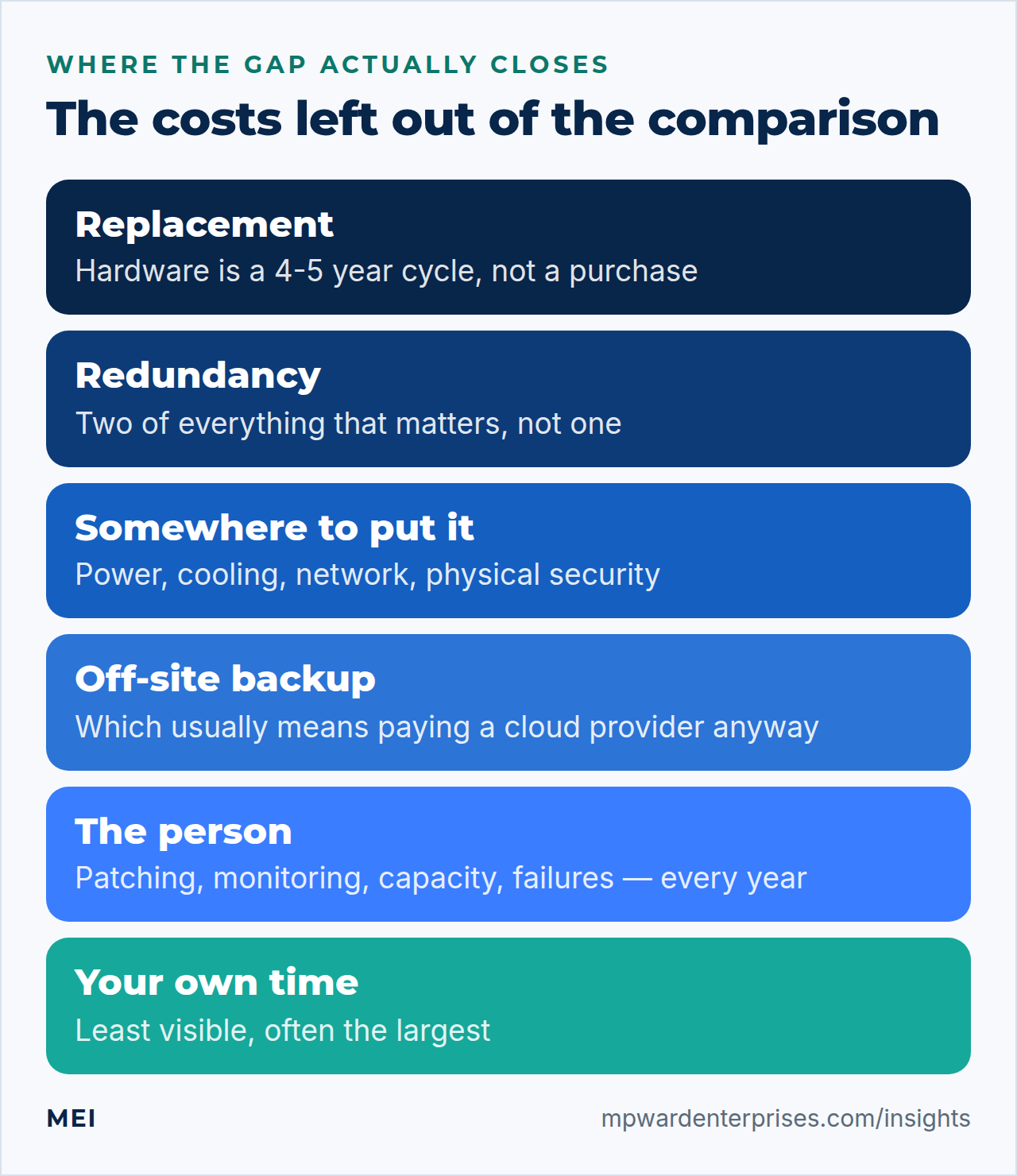
The costs that do not appear in the comparison
Private cloud comparisons tend to put hardware against monthly fees and declare victory. The missing items are where the real money is.
- Replacement, not purchase. Hardware is a recurring cost on a four to five year cycle, not a one-off.
- Redundancy. One server is not resilient. Real availability means at least two of everything that matters, which roughly doubles the hardware line.
- Somewhere to put it. Power, cooling, network, physical security. An office cupboard is not a server room, whatever it currently contains.
- Off-site backup. Private infrastructure still needs copies somewhere else, which usually means paying a cloud provider anyway.
- The person. Patching, monitoring, capacity, failures. Either a salary or a managed contract, every year.
- Your own time. The least visible cost, and often the largest in a small business.
Add those honestly and the gap narrows sharply. It does not always close — the three winning cases above survive the arithmetic — but it closes far more often than a hardware-versus-subscription table suggests.
The hybrid middle ground
Most small businesses that think they want private cloud actually want one specific thing kept close, and are happy for everything else to be somebody else's problem.
That shape works well. Keep the system with the genuine constraint — the large working files, the application with the residency requirement, the equipment-tied software — on dedicated infrastructure. Put email, collaboration, backup and the website with providers who are better at running those than you will ever be.
You get the control where it matters and avoid owning the parts that are commodity. It also fails better: when one side has a bad day, the business is not entirely stopped. The decision framework underneath is in self hosted vs cloud, and moving between the two safely is covered in our cloud migration guide.
What running it actually involves
If you proceed, these are the obligations that come with it. None is exotic; all are continuous.
Patching the hypervisor, the guests and the firmware, on a schedule rather than when something breaks. Monitoring with alerts that reach a person, covering the seven measurements in server monitoring for small business. Backups that are genuinely off-site and whose restores you have actually tested. Capacity planning, because dedicated hardware has a fixed ceiling and reaching it is your problem to foresee. Hardware replacement before failure rather than after. And a documented recovery plan that someone other than you could follow.
Written out, that list is the honest price of private cloud for small business. Businesses that budget for it are generally happy with the result. Businesses that discover it eighteen months in are the ones who call us.
How private infrastructure usually fails
It rarely fails dramatically. The common pattern is slow drift, and recognising it early is worth more than any amount of design.
Year one is good. The hardware is new, someone is interested, and everything is documented because it was just built. Year two, that person changes role or leaves, and the documentation stops matching reality. Year three, patching has become occasional because each round risks breaking something nobody fully understands any more. By year four the hardware is out of warranty, the backup job has been failing quietly for months, and the business discovers all of it at once during an incident.
Nothing in that sequence is unusual or careless. It is simply what happens to infrastructure that depends on an individual's attention rather than on a process, and small businesses are especially exposed because there is rarely a second person who knows.
Two defences work. Write down what exists and how to recover it, in a place that is not that one person's laptop, and keep it current by actually using it during drills. And put a recurring, funded obligation in the calendar — patching, restore tests, warranty review — so the work happens on a schedule rather than when someone remembers. Both are cheap. Neither happens by accident.
How to decide
Four questions, answered honestly, settle it.
- Do you have a written requirement that public cloud cannot satisfy? If not, you are choosing on preference, which is fine — but price it as preference.
- Is the workload steady and heavy? Dedicated hardware rewards predictability and punishes spikes.
- Who owns it on a Saturday? Name the person. If the answer is "we'd figure it out", that is the answer.
- Can you fund replacement in year four? If the budget covers purchase but not the cycle, the model does not work.
If the answers point to private infrastructure, build it properly with redundancy, off-site backup and monitoring from the start. If they do not, a public provider with good practices will serve you better, and that is a perfectly respectable outcome.
If you would like that assessed against your actual systems and obligations rather than in the abstract, that is our Infrastructure & Private Cloud work, and a Business Tech Rescue Audit is the usual starting point.
Frequently asked questions
What is a private cloud?
Cloud-style infrastructure provisioned for a single organisation rather than shared between tenants. NIST defines cloud by characteristics — on-demand self-service, resource pooling, elasticity and measured service — and "private" describes who it is provisioned for, not where it sits. It can be hardware in your building, in a rented cage, or dedicated hardware at a provider, and that last variant is what most small businesses actually mean.
Is a private cloud cheaper than public cloud?
Sometimes, but less often than hardware-versus-subscription comparisons suggest. Those comparisons usually omit hardware replacement every four to five years, redundancy that roughly doubles the hardware line, somewhere properly powered and cooled to put it, off-site backup (which usually means paying a cloud provider anyway), and the person who patches and monitors it. Added honestly, the gap narrows sharply.
When does private cloud actually make sense for a small business?
Three situations. When you have a written data-residency or isolation requirement from a contract, regulator or client. When the workload is predictable and heavy, since public cloud charges for elasticity you may never use. And when large data volumes move in and out regularly, where transfer charges can come to dominate the bill. Outside those, a public provider is usually cheaper, more reliable and less work.
What does running a private cloud involve?
Patching hypervisor, guests and firmware on a schedule. Monitoring with alerts that reach a person. Backups that are genuinely off-site, with restores you have actually tested. Capacity planning, because dedicated hardware has a fixed ceiling you must foresee reaching. Hardware replacement before failure rather than after. And a documented recovery plan someone other than you could follow. All of it continuous, none of it exotic.
Can I mix private and public cloud?
Yes, and that hybrid shape suits more small businesses than either extreme. Keep the one system with a genuine constraint — large working files, an application with a residency requirement, equipment-tied software — on dedicated infrastructure, and put email, collaboration, backup and the website with providers who are better at running those. It also fails better: a bad day on one side does not stop the whole business.
Is private cloud more secure?
It offers stronger isolation, which is not the same as being more secure. A well-run public deployment with multi-factor authentication, prompt patching and tested backups beats a private one that nobody updates. Private infrastructure moves the responsibility to you — you now own the controls and the evidence, which helps with some auditors and only helps in practice if someone actually does the work.
Sources and further reading
- NIST SP 800-145: The NIST Definition of Cloud Computing — the deployment models, including the definition of private cloud as single-organisation provisioning
- NIST: Cybersecurity Framework — the controls that transfer to you along with the infrastructure
- CISA: Cyber Essentials — baseline practices that decide security far more than the deployment model does