
An AI policy for small business is a short, plain-English document that says which AI tools your team may use, what they must never put into one, and who checks the output before it reaches a customer. It is not a legal exercise. One page, written once and reviewed twice a year, prevents most of the trouble that AI causes small businesses.
Your staff are already using AI. Surveys and our own client work point the same way: people quietly paste work into whatever chatbot is open, because it saves them an hour. The risk is not that they use it; it is that nobody has told them where the lines are. This guide gives you the seven rules worth writing first, a free template you can adapt in an afternoon, and the mistakes that make an AI policy useless.
What an AI policy for small business actually does
A good AI policy does three jobs and ignores everything else. It tells people which AI tools are approved, so they are not each signing up to a different service with a company credit card. It tells them what must never be pasted into one, so client data does not leave your control. And it says who is accountable for checking AI output before it goes out under your name.
Everything else — the philosophy, the ethics statement, the glossary — is optional. A one-page AI policy that people read beats a twelve-page one that sits in a shared drive. If you take nothing else from this article, write the three paragraphs above for your own business and you have covered most of your exposure.
Treat this as operational guidance rather than legal advice. If you work in a regulated field, or you handle health or financial records, your obligations are specific and worth an hour with a lawyer who knows your sector.
The seven rules to write first
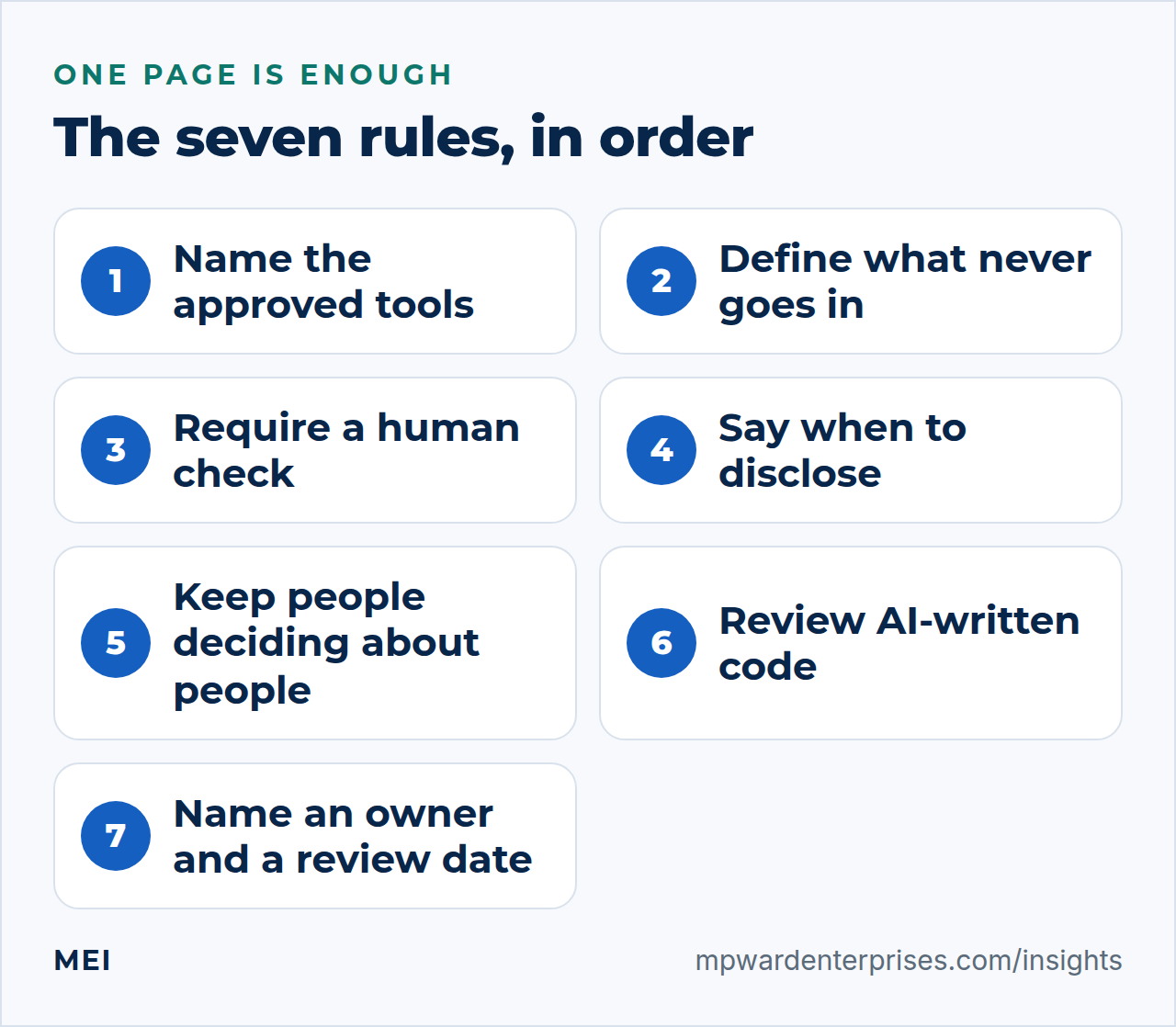
These are the rules that do the most work for the least writing. Each one is a sentence or two in the finished document.
- Name the approved AI tools. List what people may use and for what. An unnamed tool is an unapproved tool. Review the list quarterly, because this market changes faster than your policy will.
- Define what never goes in. Customer records, employee data, passwords and keys, unreleased financials, anything under an NDA, and anything you would not post publicly. Make the test memorable: if you would not email it to a stranger, do not paste it into an AI tool.
- Require a human check before anything leaves. AI output is a draft. A named person approves anything that reaches a customer, a regulator, or your website.
- Say when to disclose. Decide where you will tell people AI was involved — support replies, marketing copy, images — and be consistent. Customers forgive AI; they do not forgive being misled.
- Keep humans in charge of decisions about people. Hiring, firing, credit, pricing for an individual customer. AI can summarise; a person decides and can explain why.
- Set the rule for code and automation. AI-written code is reviewed and tested like any other code, and never pasted straight into a live site.
- Name an owner and a review date. One person owns the AI policy. Put the next review date in the document itself, or it will quietly expire.
The data question: what must never go into an AI tool
This is the rule that prevents the expensive mistakes, and the one worth spending your explaining time on. The difficulty is that the boundary is invisible: pasting a spreadsheet into a chat window does not feel like sending data to a third party, but that is exactly what it is.
Different services treat your input differently. Some consumer tiers train on what you type by default; business tiers usually do not. The practical answer for a small business is not to audit every provider's terms, but to make the rule simple enough that nobody has to: client-identifying information, credentials and anything confidential stay out, regardless of which tool is open.
- Never: customer names with their details, employee records, card or bank data, passwords, API keys, source code under contract, unreleased financials, legal documents under NDA.
- Only in an approved business-tier tool: internal drafts, anonymised examples, your own marketing copy, public documents.
- Always fine: general questions, public information, work you have invented for the purpose of asking.
Anonymising is a real option and underused. "A client in the trades with twelve staff" gets you the same quality of answer as a named business, without the exposure. Teaching that one habit does more for small business AI safety than any amount of policy text.
Who owns what AI produces
Ownership matters more than most owners expect, because it decides whether you can protect your own marketing, logo or code. In the United States, the Copyright Office has been clear that copyright protects human authorship, and that purely machine-generated material is not itself protected, while a work containing AI-assisted elements can be protected to the extent of the human contribution.
For a small business the practical consequences are narrow but real. Do not have AI generate your logo and assume you own it exclusively. Keep a record of the human work involved in anything you care about protecting. And if you commission a supplier, ask in writing whether AI tools were used and who owns the result — the same question you should already be asking about stock photography.
Approving AI tools without becoming the bottleneck
The most common failure is a policy that says "all AI tools must be approved by management" with no way to get approval. Staff do not stop using the tools; they stop telling you. A workable process takes a week to set up.
- Publish the current approved list where people actually look, not in a policy folder.
- Offer a one-paragraph request route. What the tool is, what it will be used for, what data it would touch.
- Apply a fixed test. Is there a business tier that excludes your data from training? Does it support company accounts rather than personal ones? Is there a real company behind it?
- Answer within a week, and say no clearly when the answer is no.
- Buy the business tier. The cost difference is small compared with one data incident, and it is what makes the data rule enforceable.
Company accounts matter more than people realise. When staff use personal logins, the work goes with them when they leave, and you have no way to revoke access. That is the same argument we make about every other system in your small business tech stack.
Training the team in thirty minutes
A policy nobody has read changes nothing. Thirty minutes, once, covers it: show the approved list, show two examples of something that must never be pasted in, show one example of a good anonymised prompt, and name the person who approves customer-facing output. Then put the one-page AI policy where the work happens.
Do it as a conversation rather than a lecture, and ask what people are already using. You will almost always learn about a tool you did not know was in the building. That is the point of asking: an AI policy for small business works by matching what people actually do, not by describing what you wish they did.
The free seven-point template
Copy this, fill the brackets, and delete anything that does not apply. It is deliberately short.
| Section | What to write |
|---|---|
| Purpose | "This policy says how [company] uses AI tools safely. It applies to everyone, including contractors." |
| Approved tools | "You may use [tool] for [purpose] using your company account. Anything else needs approval from [name]." |
| Never share | "Never enter customer data, employee data, passwords, keys, or confidential documents. If you would not email it to a stranger, do not paste it in." |
| Human review | "AI output is a draft. [Name or role] approves anything sent to a customer or published." |
| Disclosure | "We tell customers when [situations]. We never present AI output as personal advice from a named expert." |
| Decisions about people | "AI is never the decision-maker for hiring, discipline, credit or individual pricing." |
| Owner and review | "[Name] owns this policy. Next review: [date, within six months]." |
That is a complete AI policy for small business. If yours runs past two pages, you are writing for an auditor who is not coming.
Common mistakes that make an AI policy useless
- Banning AI outright. It drives use underground and onto personal accounts, which is the worst of both worlds.
- Copying an enterprise policy. Written for a compliance department you do not have, so nobody reads it.
- No named owner. A policy belonging to everyone belongs to nobody and is never updated.
- Listing tool categories instead of tools. "Approved generative AI assistants" tells staff nothing. Name them.
- Ignoring contractors. Your freelance designer and bookkeeper handle your data too. Say the policy applies to them.
- Writing it once. An AI policy with no review date describes a market that no longer exists within a year.
Where the policy fits with everything else
An AI policy is one control among several, and it works best alongside the basics. The NIST AI Risk Management Framework organises this as govern, map, measure and manage — for a small business, "govern" is your one-page policy and a named owner, and the rest is choosing tools deliberately and reviewing what they produce.
Most of what makes small business AI safe is ordinary security hygiene: company accounts, multi-factor authentication, and knowing which systems hold customer data. Those are the same controls in our small business cybersecurity checklist. If you are putting AI tools in front of customers — a chatbot, an automated reply — the review rule matters most, because that output speaks as your business. We cover the practical side of that in AI receptionists and automated lead follow-up, and the wider picture in AI for small business owners.
If you would like help writing the policy and choosing the tools to put in it, that is part of our AI & Business Automation work, and a Business Tech Rescue Audit will tell you what is already in use across your systems before you decide anything.
Frequently asked questions
Does a small business really need an AI policy?
If anyone in your business uses AI tools — and they almost certainly do — then yes, but it can be one page. The purpose is not compliance theatre. It is to stop customer data leaving your control, to make sure a person checks anything that goes out under your name, and to keep AI use on company accounts rather than personal ones. That is a short document, not a project.
What should never be entered into an AI tool?
Customer names with their details, employee records, card or bank data, passwords and API keys, source code you are contractually bound to protect, unreleased financials, and anything under an NDA. The simplest test that people actually remember: if you would not email it to a stranger, do not paste it into an AI tool. Anonymising works well — "a trades client with twelve staff" gets the same quality of answer without the exposure.
Can I just ban AI at work instead?
You can, and it usually fails. A ban moves AI use onto personal accounts and personal devices, where you have no visibility, no ability to revoke access, and no claim to the work. A short policy naming two or three approved tools gives people a legitimate route and gives you something to enforce.
Who owns content that AI generates for my business?
In the United States, copyright protects human authorship. The Copyright Office has stated that purely machine-generated material is not itself protected, while a work with AI-assisted elements can be protected to the extent of the human contribution. Practically: keep a record of the human work in anything you care about protecting, do not assume exclusive rights over an AI-generated logo, and ask suppliers in writing whether AI was used and who owns the result. This is general guidance, not legal advice.
How often should an AI policy be reviewed?
Every six months, with the next date written inside the document. The tools, their pricing tiers and their data-handling terms change faster than any other category of software you buy. A policy with no review date describes a market that will not exist in a year.
Does the policy apply to contractors and freelancers?
It should, and say so explicitly. Your freelance designer, bookkeeper and developer often handle more of your customer data than your own staff do. Add one sentence stating the policy applies to anyone working on your behalf, and raise it when you engage someone new.
Sources and further reading
- NIST: AI Risk Management Framework — the govern / map / measure / manage structure; for a small business, "govern" is a one-page policy and a named owner
- U.S. Copyright Office: Copyright and Artificial Intelligence — the human-authorship requirement and how it applies to AI-assisted works
- NIST: Cybersecurity Framework — the account, access and identity controls that make an AI policy enforceable in practice