
Custom software vs off the shelf is not a question of which is better. It is a question of where your business is genuinely unusual. Buy off the shelf for anything standard, such as accounting, email and payments. Build custom only where your process is your advantage, or where no product fits without painful workarounds. For most small businesses the best answer is a hybrid: configure a product, connect it to your other tools, and write a small amount of custom code where it counts.
The debate is usually framed by people who sell one side of it. This guide is written by a team that does both, so it can be blunt about the cost and the risk of each. It defines the options, gives you seven questions that decide the matter, compares the real costs over three years, and shows how to run a custom project so that you own what you pay for.
Custom software vs off the shelf: what each really means
"Off the shelf" means software you buy as it is sold. The US government's procurement rules give a precise version: a commercially available off-the-shelf item is one sold in substantial quantities in the commercial marketplace and offered without modification, in the same form in which it is sold. For a small business that means a subscription product or a boxed package: accounting software, a CRM, a scheduling tool. Thousands of other customers use the same thing, and the vendor keeps it patched and improved.
"Custom" (also called bespoke) software is written for you: a web application, an internal tool, a plugin, a dashboard or a set of scripts built around your workflow. The two are the ends of a spectrum, and most real projects sit in the middle. Between them are configurable platforms that you adapt without code, integrations that connect products through their APIs, and small custom pieces that fill gaps.
7 questions that decide custom software vs off the shelf
1. Is this process a commodity or a differentiator?
Payroll, email and card payments are commodities: customers do not choose you because your invoicing is unusual, and specialists do them better and cheaper than you can. Buy them. A scheduling method, a pricing model or a service workflow that customers choose you for is different. Custom software can encode what makes you better. If you cannot explain how the software makes you better, it is probably a commodity.
2. How well does a product actually fit?
Run a short trial against your real workflow, not a demo. If a product does most of what you need and the rest can be handled by settings, an integration or a small manual step, buy it. If you would change your whole process to suit the tool, or you need three tools and a spreadsheet to cover one workflow, the fit is poor.
3. How often do the requirements change, and who changes them?
A stable process suits a one-time build. A fast-changing one suits a product with a vendor who keeps up with it, or a platform you can reconfigure yourself. Custom software that needs a developer for every change becomes a bottleneck that is worse than the problem it replaced.
4. What does it need to connect to?
Software that stands alone is rare. Check whether the products on your shortlist have the APIs and integrations you need. An API is, in AWS's words, a mechanism that lets two software components communicate using a set of definitions and protocols. If the connections you need exist, buy and connect; if they do not, that is a strong argument for a custom piece. Our guide to API integration for small business covers the options.
5. What does it cost over three to five years?
Compare totals, not prices. Subscriptions are small each month and large over a decade. A custom build is a large first payment followed by hosting, updates and fixes. The next section works through an example.
6. Who owns the data, the code and the exit?
With a product, ask how you export your data and what happens if the vendor changes the price or closes. With custom software, ask who holds the source code, where it is hosted and whether another developer could take over. Both can lock you in; the question is which lock is easier to pick. Our self hosted vs cloud guide applies the same exit test to infrastructure.
7. Who will maintain it?
This is the question that sinks custom projects. Software ages: operating systems, browsers, libraries and the services it depends on change. If the person who built it leaves and nobody else understands it, you own a liability. Plan the maintenance before you commission the build, and prefer documented, conventional code that any competent developer can pick up.
Off the shelf software pros and cons
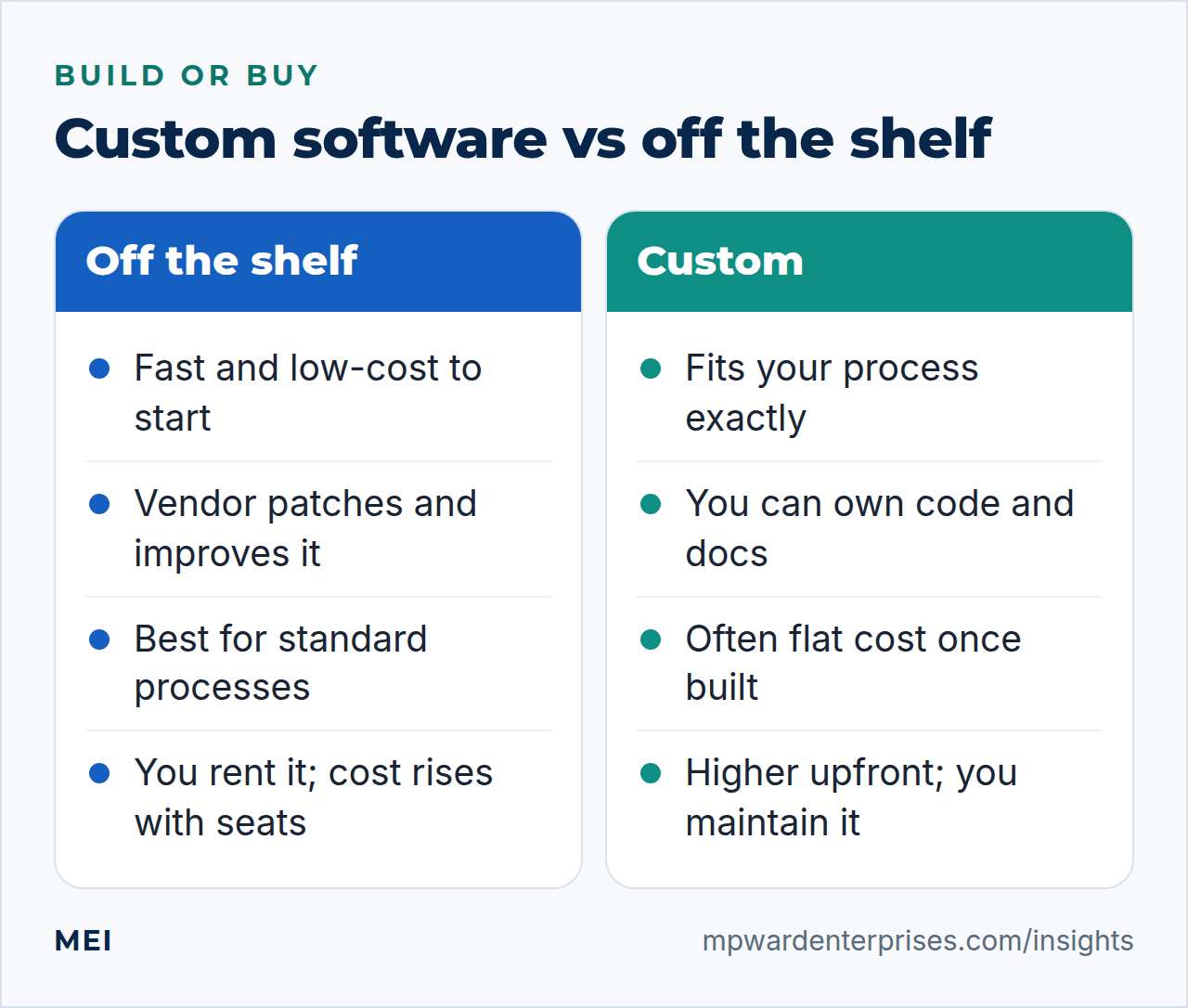
| Off the shelf | Custom | |
|---|---|---|
| Speed to start | Days or hours | Weeks to months |
| Upfront cost | Low | High |
| Fit to your process | Good for standard work, awkward for the unusual | As good as the brief you write |
| Ongoing development | Vendor's job, included in the price | Your job, paid for separately |
| Security patching | Vendor's job | Yours, or your developer's |
| Cost as you grow | Often rises per seat or per use | Often flat once built |
| Risk | The vendor changes price, features or closes | The project overruns, or the builder leaves |
| Ownership | You rent it | You can own the code and the documentation |
The real cost over three years
Custom software is mostly people's time, which is why it is priced by scope. The Bureau of Labor Statistics reports a median annual wage of $135,980 for software developers (May 2025). With benefits at about 30 percent of total employer compensation, a median-paid developer costs an employer roughly $194,000 a year, or about $93 an hour, before overhead and profit. Every hour of design, coding, testing and handover is a cost you will see in the quote.
The following illustration uses made-up round numbers to show how the comparison works. Replace them with real quotes.
| Illustration only: 10 users, 3 years | Off the shelf | Custom |
|---|---|---|
| Setup and configuration | $1,000 | $12,000 build |
| Recurring cost per month | $400 ($40 per user) | $150 hosting and support |
| Three-year recurring total | $14,400 | $5,400 |
| Three-year total | $15,400 | $17,400 |
| What the subscription also buys | New features, patches, support | Not included: fixes and changes cost extra |
On those assumptions the two are close, and the subscription includes continuing development that the custom route must also fund. Custom pulls ahead as seats grow, as the needs stay stable, or when no product fits at all. Off the shelf wins when the process is standard, the team is small or the requirements are still changing. The honest answer is that the break-even moves with every input, so run the numbers for your case.
When off the shelf wins
- The process is standard across your industry, such as accounting, payroll, email, scheduling or payments.
- A product covers most of your needs and the gaps are small or can be bridged by an integration.
- You need it running quickly and cannot fund a build.
- Your requirements are still changing and you are not sure what you need yet.
- Security, compliance or uptime matter and a specialist vendor does them better than you can.
- You have nobody to maintain custom code.
When custom software wins
- You are holding a process together with spreadsheets and manual copying, and a manual task quietly eats hours every week.
- No product fits the workflow, and bending the business around the tool would cost more than the tool.
- Two systems need to talk to each other and no integration exists.
- You pay per seat for software that few people use.
- The process is a competitive advantage that you do not want to share with every competitor who buys the same product.
- You can commit to the maintenance, or hire someone who will.
The hybrid: configure, integrate, then build only the gap
For most small businesses the best answer is neither extreme. Buy a product for the commodity parts. Configure it as far as it goes. Connect it to your other tools through integrations, which AWS describes as software components that automatically update data between clients and servers. Then write custom code only for the gap that remains, such as a small plugin, a dashboard, a script or a connector. This keeps the cost and the risk down, because the custom piece is small and the product vendor carries the rest.
A useful rule: build the smallest custom piece that removes the biggest pain, and keep it separate from the product so you can replace either one. On WordPress sites this often means a focused plugin rather than a stack of overlapping ones; see custom WordPress plugin development for when that pays off. Where the pieces live in your overall setup is covered in our small business tech stack guide.
The risks of custom software, and how to manage them
- Scope creep. Agree a fixed scope after a discovery phase, deliver in stages, and treat new ideas as a separate phase.
- Key-person dependency. Require documentation, conventional code and a handover so another developer can take over.
- Security. Custom code needs the same care as any internet-facing system. OWASP's API Security Top 10 starts with broken object level authorization and broken authentication, both mistakes that custom code makes when it is rushed. Ask how access control, input handling and secrets are managed.
- Hidden maintenance. Ask for a maintenance quote at the outset, and what it covers: security updates, compatibility fixes, hosting, backups and small changes.
- Disappearing builders. Hold the code in a repository you control, and keep copies of every credential and document.
Ownership checklist for a custom project
- The contract assigns or licenses the code to you in writing.
- The source code lives in a repository under your account.
- Hosting and domain accounts are yours, with the developer added as a user.
- Documentation is written in plain English and covers how it works, how to deploy it and how to recover it.
- There are automated tests for the critical paths.
- A staging environment exists for testing changes before they go live.
- Backups cover the code, the data and the configuration, and a restore has been tested; see the 3-2-1 backup rule.
- A named maintenance plan exists, with response times.
Getting help
If you are weighing a build, start by testing whether you need one. MEI's Custom Software Development service starts at $5,000 as a fixed scope after a discovery phase, which covers requirements, design, secure and documented code, integration with your existing systems, testing, deployment, training and documentation you own, with optional maintenance. We build software meant to be owned, understood and maintained rather than a black box you can never leave.
For a neutral second opinion on whether to buy, configure or build, the Business Tech Rescue Audit starts at $497 and maps your tools, your gaps and your options. If your pain is on a WordPress site, our WordPress Engineering service starts at $1,200, and its stated approach is to recommend the simpler, cheaper path whenever one solves the problem, even when it means less work for us.
Frequently asked questions
Is custom software worth it for a small business?
Sometimes. It is worth it when a manual process costs real hours every week, no product fits your workflow, two systems cannot talk to each other, or the process is a competitive advantage. It is not worth it for commodity work such as accounting or email, or when you cannot maintain it. Test the fit of off the shelf products first, then build only the gap.
How much does custom software cost?
It depends on scope, because the cost is mostly people's time. The Bureau of Labor Statistics median wage for software developers is $135,980, which is roughly $93 an hour in employer cost before overhead and profit. MEI's Custom Software Development starts at $5,000 as a fixed scope after discovery. Ask every provider for a written scope, a fixed price per phase and a separate maintenance quote.
What is the difference between custom, bespoke and off the shelf software?
Custom and bespoke software mean the same thing: software written for your business. Off the shelf software is bought as it is sold, used by many customers and maintained by the vendor. Between them are configurable platforms and integrations, and a hybrid of a configured product plus a small custom piece is often the best fit.
Can I start with off the shelf software and move to custom later?
Yes, and it is often the safest path. Start with a product, learn what you really need, and keep your data exportable. When a clear gap appears, build a small custom piece that connects through the product's API instead of replacing the whole product. Avoid tools that cannot export your data.
Who owns custom software?
It depends on the contract. Make sure it assigns or licenses the code to you in writing, that the source code lives in a repository under your account, and that you receive documentation and hosting credentials. MEI's approach is that you get the code, the documentation and a plain-English explanation of how it works.
What is a hybrid approach to custom software vs off the shelf?
A hybrid buys a product for the commodity parts, configures it as far as it goes, connects it to your other tools through APIs and automation, and builds custom code only for the remaining gap. It usually costs less and carries less risk than a full custom build, because the vendor maintains most of the system.
Sources and further reading
- 48 CFR § 2.101: Definitions (Federal Acquisition Regulation) — the definition of a commercially available off-the-shelf (COTS) item
- AWS: What is an API? — what an API is and how API integrations update data between systems
- US Bureau of Labor Statistics: Software Developers — median annual wage of $135,980 for software developers (May 2025)
- US Bureau of Labor Statistics: Employer Costs for Employee Compensation — benefits as 30.0 percent of total private-industry compensation (June 2026)
- OWASP: API Security Top 10 2023 — the most common API security risks, led by broken object level authorization and broken authentication