
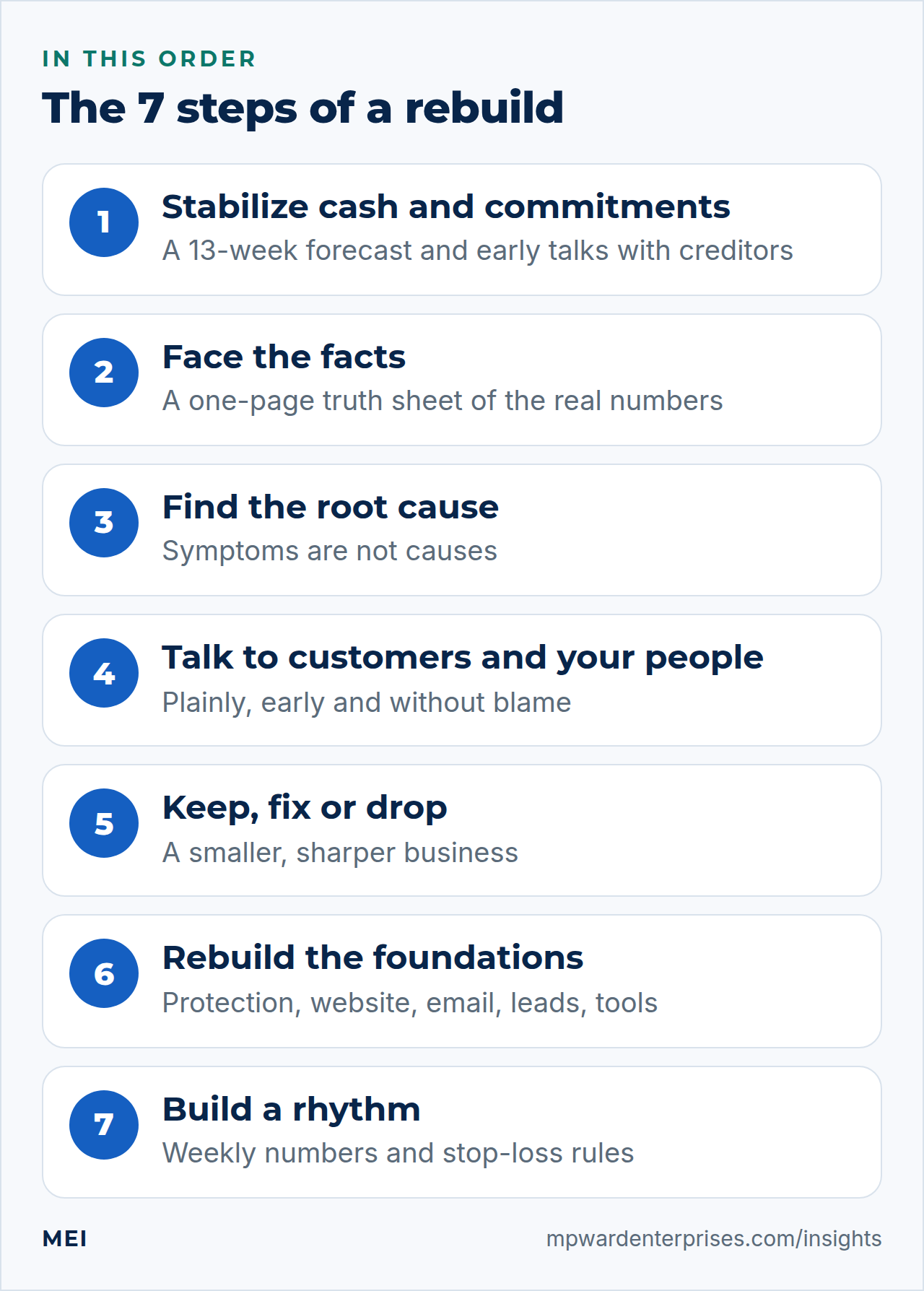
How to rebuild a business starts with an unglamorous order of operations: stabilize first, find out what actually went wrong, and only then rebuild, foundation first. The setback might be a lost anchor client, a cash crunch, a failed launch, a cyber incident or a long bad stretch. Whatever the cause, the sequence is the same one you would use to repair any failed system, and the seven steps below explain it, with the tools to use at each step and the mistakes that restart the failure.
Setbacks are common among small businesses, even though they rarely feel common from the inside. The SBA's Office of Advocacy reports that, across 1994 to 2022, an average of 49.2 percent of new employer establishments survived five years. It also reports that more than two thirds (69.5 percent) of those that reach five years reach ten. A hard stretch is a stage many owners pass through, not proof that yours is finished. What matters is what you do next, and in what order.
The method behind this guide
MEI's founder, Michael Ward, describes the same sequence in his published account on the My Story page: gather facts, challenge assumptions, isolate causes, stabilize the system, and rebuild carefully. He learned the discipline diagnosing hard-to-find faults as a master automotive technician, and applies it to websites, servers and businesses alike.
How to rebuild a business: the order that works
The urge after a setback is to do something visible: launch a promotion, rebrand, sign anyone who will pay. Resist it. A business, like an engine, can run for a while on a hidden fault, and rebuilding without finding the fault just rebuilds the failure. The order below protects you first, then informs you, then rebuilds on solid ground.
Step 1: Stabilize the cash and the commitments
In the first week, the only goal is to stop the bleeding and buy time. Start with a 13-week cash forecast: a spreadsheet with one column per week, showing opening cash, money you expect to receive (placed in the week customers actually pay, not the invoice date), money you must pay out, and closing cash. It tells you the earliest week you run out and how much time you have to act.
- Pause non-essential spending, but keep the systems that keep you operating: backups, email, the domain and the website.
- Ask your accountant which obligations carry the most serious consequences before deciding what to pay first. Payroll taxes are usually among them.
- Talk to landlords, lenders and suppliers early, with a proposal, rather than going silent. Most will prefer a plan to a default.
- Protect work already promised to customers. Delivering on commitments is the cheapest marketing you have.
- If debts are serious, speak to an attorney early, before options narrow.
Step 2: Face the facts
You cannot rebuild from numbers you have not looked at. In the first two weeks, write a one-page truth sheet: cash on hand, money owed to you and how old it is, money you owe and when it is due, debts, contracts and their end dates, revenue and margin by customer and by product, and what is in the pipeline. Be harsh with the pipeline. A lead who has not replied in a month is not revenue.
Get your bookkeeping current if it is not. The SBA recommends professional help from a certified public accountant, a bookkeeper or an online service when you need it. Honest, current numbers are what every later decision depends on.
Step 3: Find the root cause
This is the step most owners skip, and it is the one that decides whether the rebuild holds. The Institute for Healthcare Improvement puts the problem well: what we think is the cause is sometimes just another symptom. "We lost a big customer" is a symptom. The cause might be that one customer made up half your revenue, that your pricing left no margin to invest in service, or that nobody followed up on a complaint that grew.
Use a structured method. Our guide to root cause analysis for small business shows the 5 Whys and the fishbone diagram with examples. Ask "what changed?" first, because failures usually follow a change. Look at systems and processes before people, and write down the cause in a sentence you could act on.
Step 4: Talk to your customers and your people
Silence breeds rumors. Tell staff, key customers and suppliers what has happened, what you are doing and what happens next, in plain language and without blame. NIST's recovery guidance includes communicating regularly and securely with internal and external stakeholders, and the principle applies well beyond cyber incidents.
Then listen. Call your ten best customers and ask what they value, what nearly made them leave and what they would pay more for. This is cheap, fast market research, and it often reveals that the thing you take for granted is the thing they love.
Step 5: Decide what to keep, fix or drop
You cannot rebuild everything at once, and you should not try. Ready.gov's business continuity guidance states a useful rule for sequencing: restore first the processes with the greatest operational and financial impact. Apply it to the whole business. Sort every product, service and customer segment into one of three groups.
| Group | Typical signs | What to do |
|---|---|---|
| Keep and protect | Healthy margin, steady demand, customers who stay | Defend it, make it easy to buy, and build around it |
| Fix | Real demand but poor margin or delivery problems | Reprice, simplify or change the process; set a deadline to review it |
| Drop | Low margin, high effort, slow payers, distractions | Stop selling it, refer customers elsewhere, free the time |
The result is usually a smaller, sharper business. That is a feature. A tighter offer is easier to sell, deliver and run with fewer people.
Step 6: Rebuild the foundations in order
With the cause known and the offer chosen, rebuild the systems underneath, starting with the ones everything else depends on. NIST advises prioritizing recovery actions based on organizational needs, resources and the assets affected. For most small businesses, this order works.
| Order | Foundation | First action | Guide |
|---|---|---|---|
| 1 | Access and protection | Multi-factor authentication, tested backups | Cybersecurity checklist, 3-2-1 backup rule |
| 2 | Website and email that work | Test forms, fix email authentication | Contact form fixes, emails going to spam |
| 3 | Lead capture and follow-up | One place for leads, fast replies | Automated lead follow up |
| 4 | A simple, owned tool set | List your tools, owners and exits | Small business tech stack |
| 5 | Continuity | A one-page plan with recovery targets | Business continuity plan |
| 6 | Time back | Automate one repetitive job | AI for small business owners |
Step 7: Build a rhythm and guard against relapse
Rebuilding ends when good habits run without heroics. Set a weekly 30-minute review of five numbers: cash, pipeline, response time to new leads, delivery on time, and one customer conversation. Hold a monthly review of margin and the stack, and a quarterly look back. NIST recommends an after-action report that documents what happened, the actions taken and the lessons learned; do one after every serious incident, and write down the early-warning signs you missed.
Add stop-loss rules in advance, such as "if cash falls below four weeks of costs, we cut spending X and Y". Decisions made calmly beforehand beat decisions made in a panic. Keep your systems maintained with a routine like our WordPress website maintenance checklist.
Your first 30 days
| Week | Focus | Done when |
|---|---|---|
| 1 | Stabilize | 13-week cash forecast built, creditors contacted, spending paused, accountant engaged |
| 2 | Facts and cause | Truth sheet written, root cause analysis started, key customers called |
| 3 | Decide | Keep, fix and drop lists made; staff and suppliers briefed |
| 4 | Begin the rebuild | First foundation tasks done, weekly review scheduled, advisor booked |
Mistakes that restart the failure
- Hiding the numbers. From yourself, your partner or your advisors. Problems shrink when they are visible.
- Borrowing to cover operating losses without fixing the cause. New debt on top of an unfixed problem makes the next failure larger.
- Chasing any revenue at any price. Low-margin work can deepen the hole.
- Rebuilding everything at once. Sequence beats speed.
- Skipping the cause. Without it you are renovating on the same fault line.
- Neglecting backups, security and maintenance. A second blow, such as a cyber incident, is the cruelest kind.
- Going it alone. Isolation narrows your options and your judgment.
If the setback was a cyber incident or a major outage
When the cause is technical, the same order applies, with a few specifics. NIST's small business guide advises assessing the integrity of backed-up data and assets before you use them for restoration, so a clean restore does not bring the problem back with it. Change every credential that could have been exposed, turn on multi-factor authentication, and check for ways an intruder could return before you reopen. Prioritize restoring the systems that earn money first.
Tell customers promptly if their data may have been affected; legal duties vary, so take advice. Then write the after-action report and fix the cause, not just the damage. Our small business cybersecurity checklist gives the controls in priority order, and the business continuity plan guide shows how to be ready next time.
Look after the person doing the rebuilding
A rebuild is a long stretch of high stress, and it asks most of the one person who cannot easily be replaced. The World Health Organization describes burn-out as a syndrome resulting from chronic workplace stress that has not been successfully managed. Plan your own recovery the way you plan the company's: sleep, time off, someone to talk to. Our guide to small business owner burnout lists the warning signs and the fixes.
If stress turns into thoughts of harming yourself, treat it as an emergency. In the United States you can call or text 988 to reach the 988 Suicide & Crisis Lifeline, which is free, confidential and available 24 hours a day, every day.
When rebuilding means winding down or selling
Sometimes the honest answer is that the business should close, merge or be sold. That is a decision, not a failure, and doing it deliberately usually costs less than being forced into it. An accountant and an attorney can tell you what the options and obligations are in your situation. Keep records, treat customers and staff fairly, and take what you learned into whatever you build next.
Where to get help
You do not have to do this alone, and some of the best help is free. The SBA says it and its network of partners offer free or low-cost counseling and training, including Small Business Development Centers, SCORE business mentoring, Women's Business Centers and Veterans Business Outreach Centers. Find them on the SBA's local assistance page.
For the technology part of the rebuild, MEI's Business Tech Rescue Audit starts at $497. It is a practical diagnostic of your website, email, forms, hosting, security, backups and workflows together, by someone who can explain what is actually wrong, and it ends with a prioritized plan. You can read more about the person behind that approach on the Meet Michael Ward page.
Frequently asked questions
How do you rebuild a failing business?
Rebuild in order. First stabilize cash and commitments with a 13-week forecast and early conversations with creditors. Then get the real numbers, find the root cause, talk to customers and staff, decide what to keep, fix or drop, rebuild the foundations (access, backups, website, email, lead follow-up), and set a weekly rhythm. Skipping the root cause is the most common reason rebuilds fail.
How long does it take to rebuild a business?
There is no fixed timeline. Stabilizing cash and getting the facts often takes the first two to four weeks, and the rebuild itself usually takes several months, depending on the cause and the size of the business. Measure progress by milestones, such as cash positive weeks, a working lead process and recovered customers, rather than by the calendar.
How do I recover from business failure?
Treat it as information. Write an honest account of what happened, find the root cause, document the lessons, and decide whether to rebuild, change direction or close deliberately. Look after your health, use free counseling such as SCORE mentors and Small Business Development Centers, and speak to an accountant and an attorney about obligations.
Should I rebuild my business or start over?
Rebuild if there is real demand, customers who value what you do and a fixable cause. Consider starting over or winding down if margins cannot support the business, the cause cannot be fixed, or continuing is costing more than the business can ever recover. An accountant, an attorney and a business mentor can help you decide with real numbers.
What is the first thing to do when a business is in trouble?
Build a 13-week cash forecast, so you know how much time you have. Then pause non-essential spending, protect the systems that keep you operating, contact creditors and suppliers with a plan, and get your accountant involved. Stabilizing buys the time you need to find and fix the cause.
Where can I get free help rebuilding my business?
The SBA and its partners offer free or low-cost counseling and training, including Small Business Development Centers, SCORE business mentoring, Women's Business Centers and Veterans Business Outreach Centers. MEI's Business Tech Rescue Audit, from $497, covers the technology side of a rebuild.
Sources and further reading
- SBA Office of Advocacy: Frequently Asked Questions About Small Business (February 2026) — new employer establishment survival rates for 1994 to 2022
- NIST SP 1300: Cybersecurity Framework 2.0 Small Business Quick-Start Guide — prioritizing recovery actions, communicating with stakeholders and after-action reports (February 2024)
- Ready.gov: Business Impact Analysis — restore first the processes with the greatest operational and financial impact
- Institute for Healthcare Improvement: 5 Whys, Finding the Root Cause — what we think is the cause is sometimes just another symptom
- SBA: Manage your finances — getting help from a CPA, a bookkeeper or an online service
- SBA: Local assistance — free or low-cost counseling and training through SBDCs, SCORE and other partners
- World Health Organization: Burn-out an occupational phenomenon (ICD-11) — the definition of burn-out
- 988 Suicide & Crisis Lifeline — free, confidential support by call, text or chat, 24 hours a day in the United States