
Small business owner burnout is what happens when chronic work stress that never switches off wears down your energy, your motivation and your judgment. The World Health Organization describes burn-out as a syndrome resulting from chronic workplace stress that has not been successfully managed, marked by exhaustion, mental distance or cynicism about the job, and reduced effectiveness. An owner has nobody to hand the stress to. This guide lists eight warning signs and eight practical fixes, including the technology causes of overload that you can remove.
It is written for owners who are tired in a way that sleep does not fix, and for the people who work with them. It is general information, not medical advice. If you recognize yourself here, that is useful information, not a verdict.
If you are in crisis
If you are thinking about harming yourself or feel you cannot go on, treat it as an emergency. In the United States, call or text 988 to reach the 988 Suicide & Crisis Lifeline, or call emergency services. The Lifeline says its conversations are free and confidential, and that it is available 24 hours a day, every day, for anyone facing emotional distress, mental health struggles or alcohol or drug use concerns, or who just needs someone to talk to.
What is small business owner burnout?
The WHO's definition, in the International Classification of Diseases, has three dimensions: feelings of energy depletion or exhaustion; increased mental distance from one's job, or feelings of negativism or cynicism about it; and reduced professional efficacy. It classes burn-out as an occupational phenomenon, referring specifically to the context of work, not as a medical condition. That distinction helps: the cause lies in how the work is structured and managed, which means the work can be changed.
Owners are exposed for structural reasons. You carry every decision, the financial risk and the customer relationships. You are the help desk, the accountant and the only person who knows the passwords. There is no sick day, and often no handover. Stress, in the National Institute of Mental Health's words, is the physical or mental response to an external cause, and it can be short-term or repeated over a long time. Burnout is what long, repeated, unmanaged stress can become.
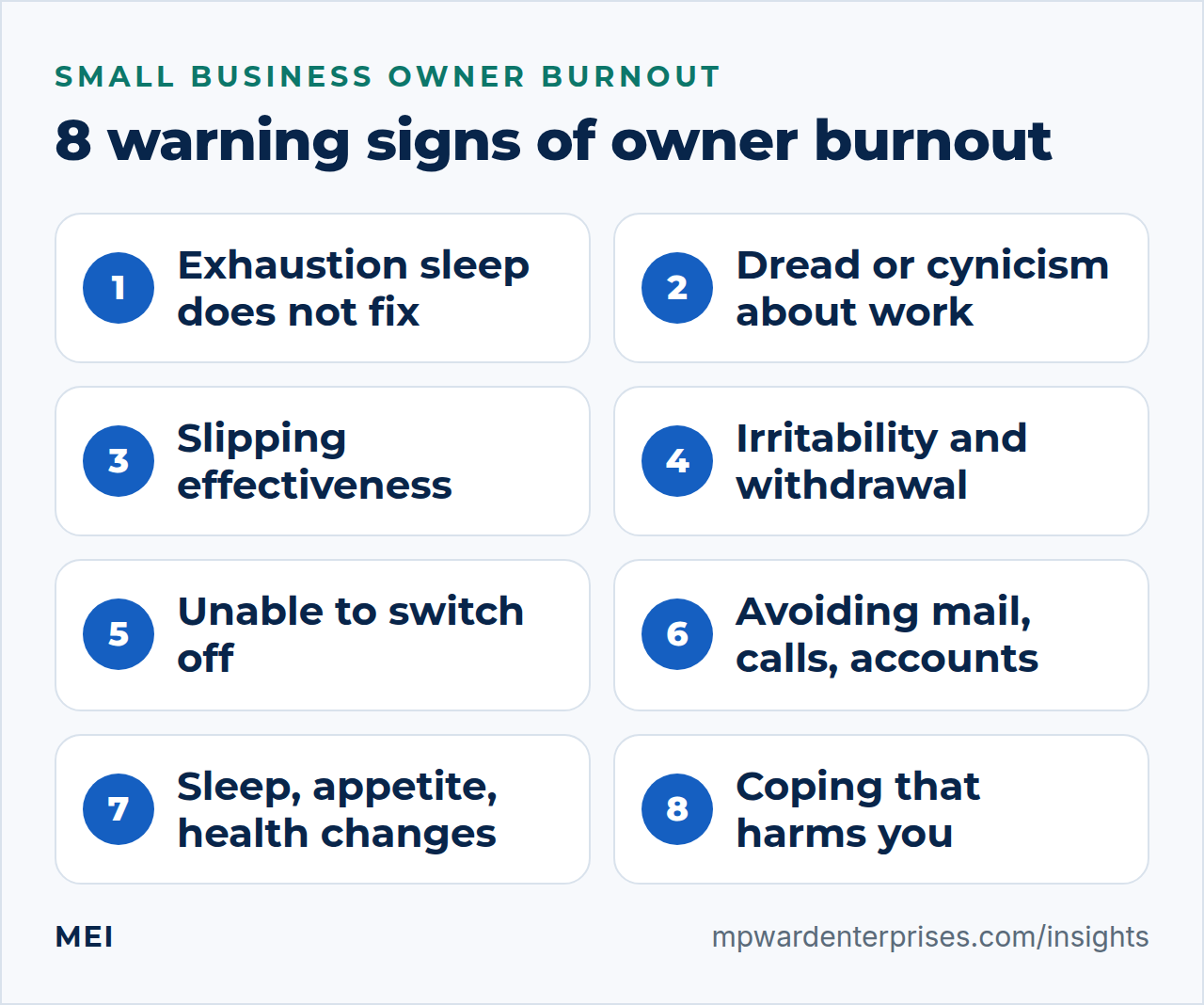
8 warning signs of small business owner burnout
No single sign proves anything, and these are not a diagnosis. A pattern, especially one that lasts weeks, is worth taking seriously.
- Exhaustion that sleep does not fix.You wake tired, run on caffeine and dread the day. This is the WHO's first dimension, energy depletion.
- Dread or cynicism about the work.Customers feel like interruptions, and a business you built feels like a burden. This is the second dimension, mental distance and negativism.
- Slipping effectiveness.More mistakes, forgotten commitments, trouble making decisions or concentrating. This is the third dimension, reduced professional efficacy.
- Irritability and withdrawal.Short with staff, family or customers, and avoiding the people who could help.
- You cannot switch off.Email at midnight, a phone always in hand, no real day off in months, and guilt when you rest.
- Avoidance.Unopened mail, unanswered calls, unreviewed accounts and tasks that pile up. NIMH lists avoiding things among the reasons to seek help.
- Changes in sleep, appetite or health.NIMH notes that prolonged stress can cause problems with sleeping and with the immune, digestive and cardiovascular systems.
- Coping that harms you.More alcohol or other substances than you intend, or a creeping sense of hopelessness. If this is you, talk to someone today.
When to get professional help
NIMH's guidance on stress is a useful yardstick. It says to seek help if symptoms interfere with your everyday life, cause you to avoid doing things, or seem to be always present, and to seek professional help if the symptoms of stress or anxiety will not go away. It also notes that prolonged stress raises the risk of anxiety disorder or depression, which can look like burnout from the outside and need a clinician to tell apart.
A doctor, a therapist or an employee assistance program is the right first call; there is no need to wait until you are in crisis.
Stress, burnout and depression: how they differ
People use the three words interchangeably, but they are different, and the difference decides who can help. Use this table as a rough guide and let a professional make the call.
| Stress | Burnout | Depression | |
|---|---|---|---|
| What it is | The body and mind's response to an external demand | A syndrome from chronic workplace stress that has not been successfully managed | A medical condition that a clinician diagnoses |
| How it tends to feel | Pressured, overloaded, often urgent | Empty, detached, cynical about the work | Persistent low mood or loss of interest that spreads beyond work |
| Where it shows up | Anywhere | Specifically in the work context | Across life, not only work |
| What helps first | Rest, planning, support | Changing the load and the work, plus support | Professional evaluation and treatment |
Because the WHO describes burn-out as referring specifically to the occupational context, low mood that colors every part of life deserves a conversation with a doctor or therapist, not just a lighter workload.
8 fixes for small business owner burnout
1. Name it and tell someone
Say it out loud to a person you trust: a partner, a friend, a mentor, a doctor. NIMH's advice includes reaching out to friends or family who help you cope in a positive way. Isolation narrows your options and your judgment, and owners are often isolated by default.
2. Protect the basics
NIMH's coping suggestions are plain: exercise and eat regular, healthy meals, and keep a sleep routine that gets you enough sleep. They are not glamorous, and they are the first things an overloaded owner drops. Schedule them as you would a client meeting.
3. Set boundaries on availability
You decide when the business is open. Publish hours, use an out-of-office message and an automatic reply, and set response targets: same day for customers, within an hour only for true emergencies. Take work email off your phone at night, or use a separate profile. Customers adapt faster than you expect.
4. Delegate or automate the repeatable work
List everything you did last week and mark what a person with less experience, or a system, could do. Follow-ups, reminders, invoicing, scheduling and first drafts are the usual candidates. Our guides to automated lead follow up and AI for small business owners show where automation helps and where to keep a human.
5. Remove the technology causes of overload
For many owners, a large share of the stress is technical: the fear of an outage, the lost lead, the unknown password. The next section covers these specifically, because they are the part you can fix fastest.
6. Write it down so you are not the only one who knows
Being the single point of failure is exhausting. Put processes on one page, keep credentials in a company password manager with a second administrator, and write a short business continuity plan so that if you are unwell or away, someone else knows what to do.
7. Take real time off, with cover
A day off that you spend checking email is not a day off. Plan time away like a project: brief a deputy, set up forwarding and monitoring, and agree who decides what. Start with a long weekend to prove that the business survives it.
8. Get outside perspective
The SBA says it and its partners offer free or low-cost counseling and training through Small Business Development Centers, SCORE mentors, Women's Business Centers and Veterans Business Outreach Centers. A mentor who has run a business, or an accountant who sees your numbers, can tell you whether your load is normal or whether the model needs to change, through pricing, scope or saying no.
Remove the technology causes of overload
| What is draining you | What helps | Guide |
|---|---|---|
| Chasing missed calls and leads at night | Instant replies, alerts and an after-hours assistant | AI receptionist, lead follow up |
| Outages and surprise problems | Monitoring, updates on a schedule, root-cause fixes | Maintenance checklist, root cause analysis |
| "Only I know the passwords" | A password manager, a second administrator, written procedures | Tech stack register |
| Fear of losing everything | Tested backups and a recovery plan | 3-2-1 backup rule |
| Retyping data between tools | Integrations between your systems | API integration |
| Worry about hackers and scams | A prioritized set of basic controls | Cybersecurity checklist |
| Not knowing what IT really costs | A clear scope and price | IT support cost |
Two habits help more than most. First, make a short "not-doing" list: three things you will stop doing this quarter because they drain you and earn little, such as the lowest-margin customer or the report nobody reads. Second, schedule one conversation a month about something other than the business with someone who is not on your payroll. Both sound small. Both are the first things to go when you are overloaded, which is exactly why they matter.
A 15-minute weekly reset
Once a week, write answers to six questions. They take 15 minutes and show you the pattern before it becomes a crisis.
- What drained me this week, and what gave me energy?
- What is one task I can delegate, automate or stop?
- Did I have a real break, and when is the next one?
- Did I sleep, eat and move enough, or did I skip them?
- Who did I talk to about something other than work?
- What is the one thing that would make next week lighter?
If you are worried about an owner you know
If the owner is a partner, a parent or a friend, you may see the signs before they do. Choose a private moment and say what you have noticed, without judgment: "You have seemed exhausted for a while, and I am worried about you." Ask how they are, then listen more than you advise. Offer something concrete, such as covering a task or going with them to an appointment, and encourage them to talk to a doctor, a counselor or a mentor.
If you think someone is in immediate danger, do not wait. Call emergency services, or call or text 988 in the United States. Staying in touch afterwards matters as much as the first conversation.
A note from the people behind this guide
MEI's founder, Michael Ward, has written openly on his My Story page about a period when pressures compounded until he could no longer see a workable future, and about learning to say so plainly. He writes that some systems fail slowly, and that he knows exactly what happens when warning signs are ignored. We include that here, with his page as the source, because the warning signs in this guide are worth heeding, and because asking for help is an act of responsibility, not weakness.
Where MEI fits
MEI cannot treat burnout, and nobody should pretend a service can. What a technology partner can do is take away the parts of the load that are technical. Our Managed Website & IT Care starts at $149 a month and provides monitoring, backups, updates, reporting and dependable access to technical help, so problems are caught before they become emergencies. If you are not sure what is draining you, the Business Tech Rescue Audit starts at $497 and finds the fragile points across your website, email, hosting, security and workflows.
And if your business is in a deeper hole, read how to rebuild a business.
Frequently asked questions
What are the signs of burnout in a business owner?
Common signs include exhaustion that sleep does not fix, dread or cynicism about the work, slipping effectiveness, irritability and withdrawal, being unable to switch off, avoiding mail, calls or accounts, changes in sleep, appetite or health, and coping that harms you. A pattern lasting weeks is worth taking seriously and discussing with a professional.
How do I recover from burnout as a business owner?
Recovery works on both the person and the load. Tell someone you trust, protect sleep, food and movement, set boundaries on availability, delegate or automate repeatable work, remove technology causes of overload, write things down so you are not the only one who knows, take real time off with cover, and get outside perspective from a mentor, accountant or professional.
What is the difference between stress and burnout?
Stress is the physical or mental response to an external demand and can come from anywhere. Burnout, as the World Health Organization defines it, results from chronic workplace stress that has not been successfully managed and refers specifically to the work context. Depression is a medical condition that a clinician diagnoses and is not limited to work.
Can I take time off if I run my own business?
Yes, with planning. Brief a deputy, write down the essentials, set up forwarding, monitoring and backups, and agree who decides what. Start with a long weekend to prove the business survives it, then build up. A short continuity plan makes time off far less stressful.
How long does it take to recover from burnout?
It varies, and no single timeline applies. Recovery usually depends on changing the conditions that caused it, not only resting, so it can take weeks or months. If your symptoms interfere with everyday life, cause you to avoid things or will not go away, seek professional help rather than waiting.
When should I see a professional about work stress?
The National Institute of Mental Health advises seeking help if stress symptoms interfere with your everyday life, cause you to avoid doing things, or seem to be always present. If you are thinking about harming yourself, call or text 988 in the United States or contact emergency services.
Sources and further reading
- World Health Organization: Burn-out an occupational phenomenon (ICD-11) — the definition of burn-out and its three dimensions
- National Institute of Mental Health: I'm So Stressed Out! Fact Sheet — what stress is, how it affects the body, coping strategies and when to seek help
- 988 Suicide & Crisis Lifeline — free, confidential support by call, text or chat, 24 hours a day in the United States
- SBA: Local assistance — free or low-cost counseling and training through SBDCs, SCORE and other partners